

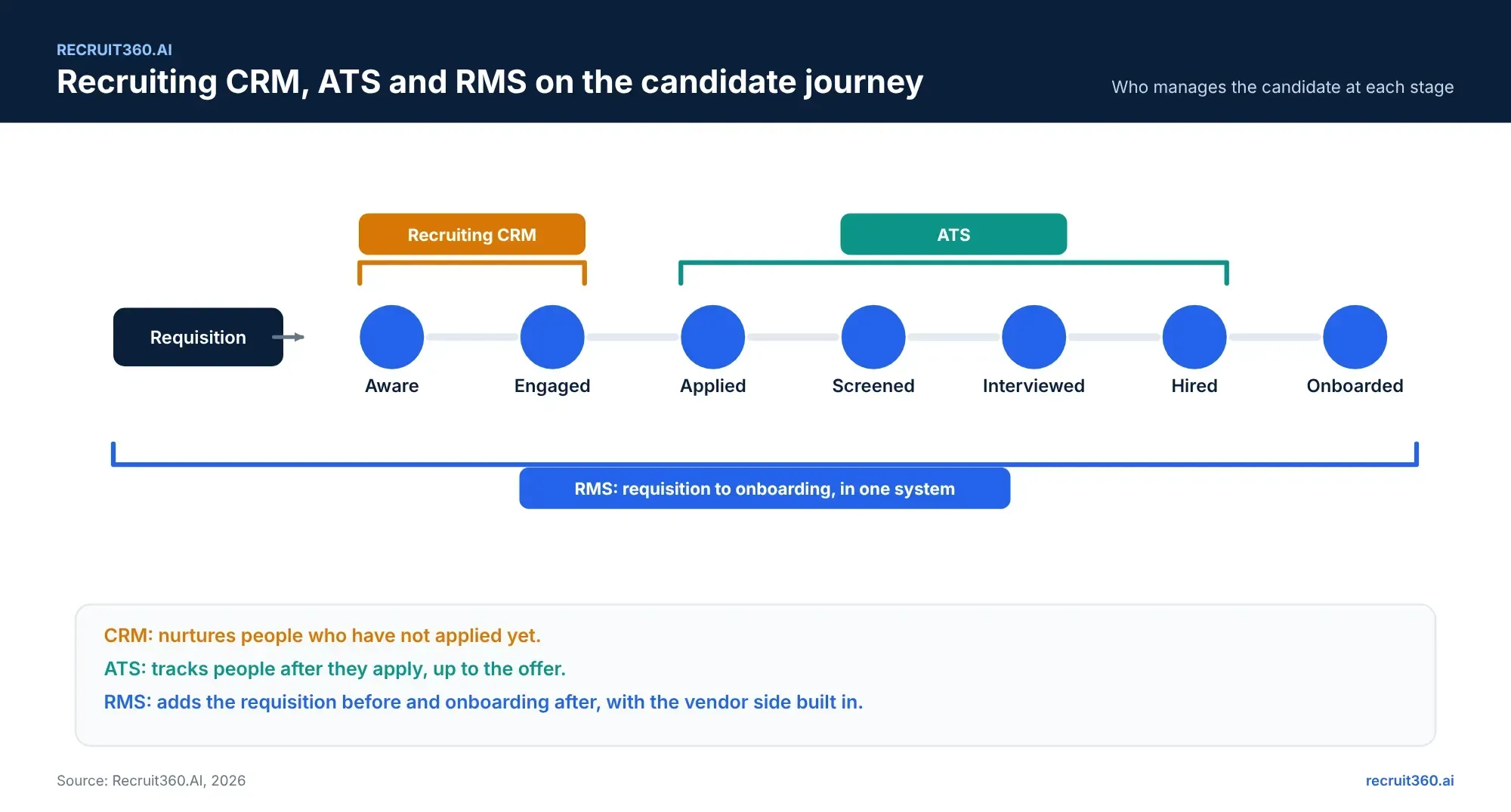
An applicant tracking system (ATS) manages candidates from the moment they apply to the moment they accept an offer. A recruiting CRM manages people before they apply: talent pools, outreach and nurture. A recruitment management system (RMS) covers both ends and adds what neither has: requisition approval before the job exists, a vendor portal for agencies, and reporting on the whole process. Most RMS software includes an ATS. Most teams need one of the three, not all of them.
Key takeaways:
- CRM is before the application. ATS is after. RMS is the whole journey plus the requisition.
- The difference between a recruiting CRM and an ATS is who is in it: prospects vs applicants.
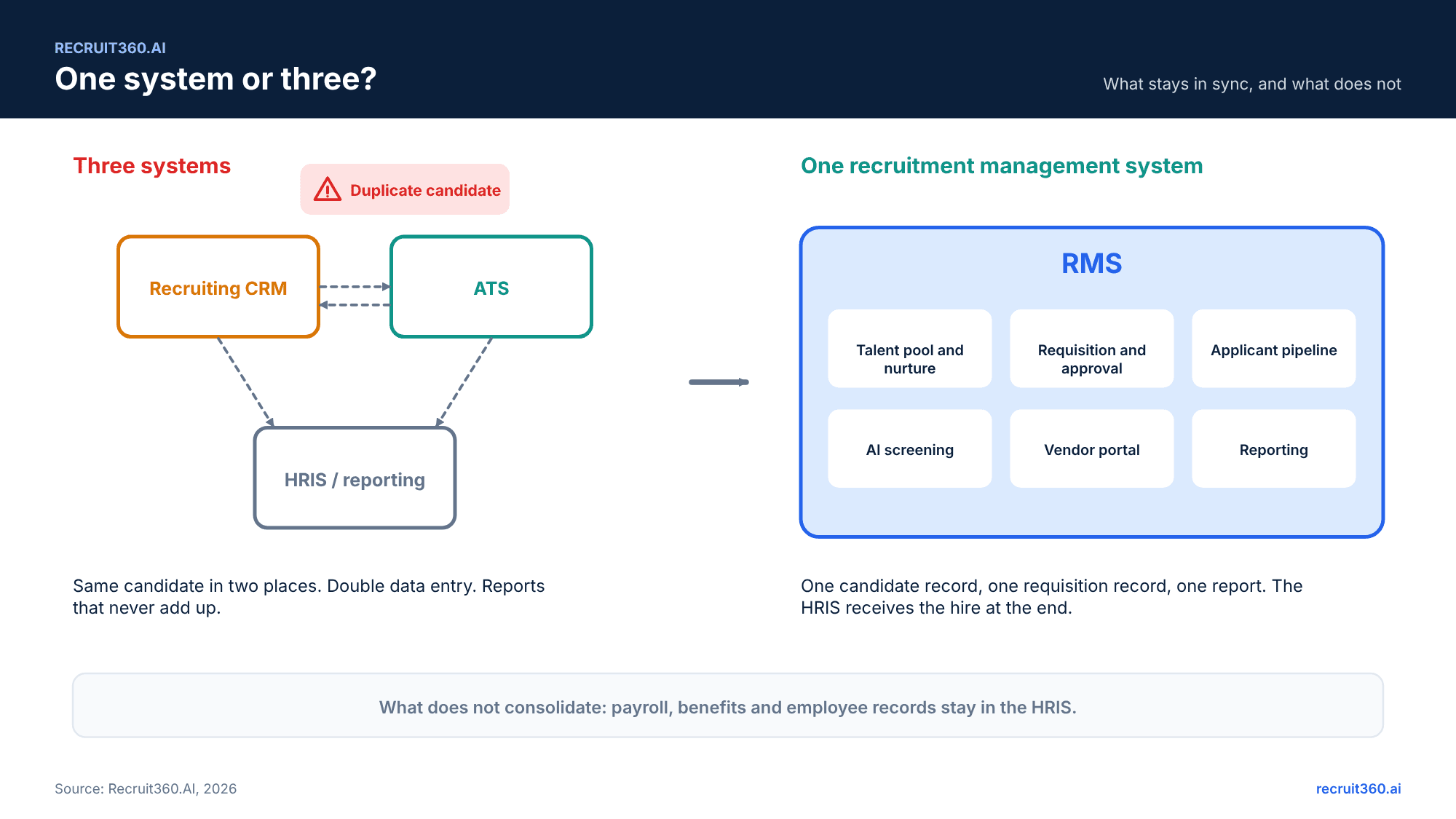
- Running three systems means the same candidate in three places and reports that never add up.
- Pick by team shape: in-house corporate teams, staffing agencies and enterprise HR each land in a different place.
Three letters each, and vendors use them interchangeably. Crelate's comparison opens by pointing out that CRM alone can mean two different things in recruiting, candidate relationship management or customer relationship management, before the ATS question even starts (Crelate). "Is an RMS just an ATS with a bigger price tag?" is the question hiring teams ask most on vendor calls. This post takes the three systems a hiring team chooses between, puts them on one candidate journey, walks through the five differences between an RMS and an ATS that show up in daily work, and ends with a five-question test and a migration guide..
For the base definition, start with what a recruitment management system is. If you are comparing vendors rather than categories, the best recruitment software for staffing agencies in India list is the next read.
The three systems at a glance
| Recruiting CRM | Applicant tracking system | Recruitment management system | |
|---|---|---|---|
| Who it manages | Prospects who have not applied | Applicants in the pipeline | Everyone, from requisition to hire |
| Before or after apply | Before | After | Both, plus the requisition before posting |
| Core job | Talent pools, outreach campaigns, nurture | Stage tracking, interviews, compliance | Approval, screening, collaboration, vendors, reporting |
| AI role | Outreach suggestions, timing | Filters; scoring in newer tools | Semantic matching, scoring, ranking with reasons |
| Vendor portal | No | Rare | Built in |
| Reporting | Engagement and conversion to apply | Applications and pipeline counts | Whole funnel by stage, department and agency |
| Typical user | Sourcer, employer brand | Recruiter | Recruiter, hiring manager, TA leader, HRIS admin |
| Best for | Teams that source passive candidates | Teams with inbound volume and a simple process | Teams with approvals, agencies and many hiring managers |
What a recruiting CRM does
Candidate relationship management software holds people who might apply one day. Past applicants who were strong but not hired. Engineers a sourcer found on a conference list. Alumni. The CRM keeps them warm.
Talent pools and nurture campaigns
A recruiting CRM groups prospects into pools by skill or location, runs outreach sequences, tracks who opened and replied, and tells the sourcer when a pool member looks ready to move. It is marketing software pointed at candidates.
Where a recruiting CRM stops
At the application. Once the person applies, the CRM hands them to whatever runs the pipeline. A CRM has no interview stages, no requisition approval, no agency portal and no hiring report. Teams that try to run hiring in a CRM end up with a pipeline built from tags.
What an applicant tracking system does
An ATS holds people who have applied. It moves them through stages, stores the resume and the interview notes, and keeps the compliance record.
Pipeline tracking and compliance
New, screened, interview, offer, hired, rejected. Every applicant has a stage and a date. Every communication is logged. For a company that has to show how it treated applicants, the ATS is the evidence.
Where an ATS stops
It starts late and ends early. It does not know about the requisition that created the job or the approvers who signed it. It does not give agencies a login. It gives hiring managers a view they rarely open. And it reports on applications, not on the process around them.
What a recruitment management system does
An RMS holds the whole process. It includes the ATS pipeline. It adds the stages before and after, and the people an ATS leaves out. Our guide to what a recruitment management system is covers each stage.
Requisition to onboarding in one system
The hiring manager requests the role. Approvers sign off inside the system. The job posts and, through the vendor portal, reaches the agencies you choose. AI screening ranks every candidate, agency or direct. Interviews are scored on the record. The hire moves to the HRIS. The report writes itself from the stage dates. Many RMS platforms, including Recruit360.AI, also keep a talent pool of past candidates, which covers the CRM job for most in-house teams.
Where an RMS stops
It is not an HRIS: payroll, benefits and the employee record after day one live elsewhere. And it is not a sourcing engine: it manages the candidates you have rather than searching the open web for the ones you do not. A team that lives on outbound sourcing may still want a dedicated CRM beside it.
The full selection process, with a scoring matrix, is in our guide on how to choose recruitment software.
RMS vs ATS: five differences that matter in practice
The RMS and the ATS share a pipeline, a candidate database and a lot of screenshots. The difference between RMS and ATS is scope: same middle, different ends. These five show up in a recruiter's week.
1. Requisition and approval workflow
In an ATS, the job appears when a recruiter creates it. In an RMS, the job appears when a hiring manager requests it and the approvers sign off. The gap between request and approval is measured, so you know when hiring delays start before recruiting even begins.
2. Screening: keyword filters vs AI matching
An ATS filters on keywords and knockout questions. If the resume says "growth hacker" and the job says "performance marketer", the filter misses. An AI recruitment management system matches on meaning, scores the fit and shows the reason. The recruiter still decides; the list they start from is better.
3. Staffing agencies and the vendor portal
With an ATS, agency candidates arrive by email. Two agencies send the same person and nobody knows who was first. With an RMS, agencies submit through a vendor portal. The system records the source, checks for duplicates and reports fill rate by agency.
4. Hiring manager collaboration
An ATS gives hiring managers a view. An RMS gives them a job: approve the requisition, review the ranked shortlist, score the interview. Because the work is inside the system, the feedback is too.
5. Reporting on the whole hiring funnel
An ATS reports on applications. An RMS reports on the process: requisition age, time to fill by department, stage conversion, source of hire and agency performance. The report leadership wants comes from the system, not from a recruiter's Saturday.
The cost of running two or three systems
The argument for a single system is not elegance. It is the two problems that show up within a quarter of running separate tools.
Duplicate candidates and double data entry
The same person is in the CRM as a prospect, in the ATS as an applicant, and in the agency's email as a submission. Three records. Three sets of notes. A recruiter updates one and the other two go stale. Someone re-keys the hire into the HRIS at the end.
Reporting that never adds up
The CRM reports conversion to application. The ATS reports applications to hire. Neither knows how long the requisition waited for approval, so time to fill is a guess. The talent acquisition leader builds the real number in a spreadsheet from three exports.
Which system fits your team?
In-house corporate recruiting teams
If requisitions need approval, agencies send candidates and hiring managers need to score interviews, you have outgrown an ATS. An RMS with a built-in talent pool covers the CRM job for the past candidates you want to keep warm. Add a dedicated CRM only if outbound sourcing is most of your hiring.
Staffing agencies
Agencies live on candidate relationships, so a recruiting CRM or an agency ATS with CRM features is the core. When a client runs an RMS, the agency submits through the client's vendor portal and keeps its own system for its own candidates. Agencies managing many clients can run an RMS themselves to track requisitions per client.
Enterprise HR with an HCM suite
If recruiting already runs inside a suite such as Workday or SAP SuccessFactors, the question is what the suite misses. Usually that is AI screening with reasons, a vendor portal and hiring manager tools. An RMS that integrates to the suite's HRIS fills those gaps without replacing the employee record.
The 5-question test: do you need an RMS or an ATS?
Answer yes or no. Count the arrows.
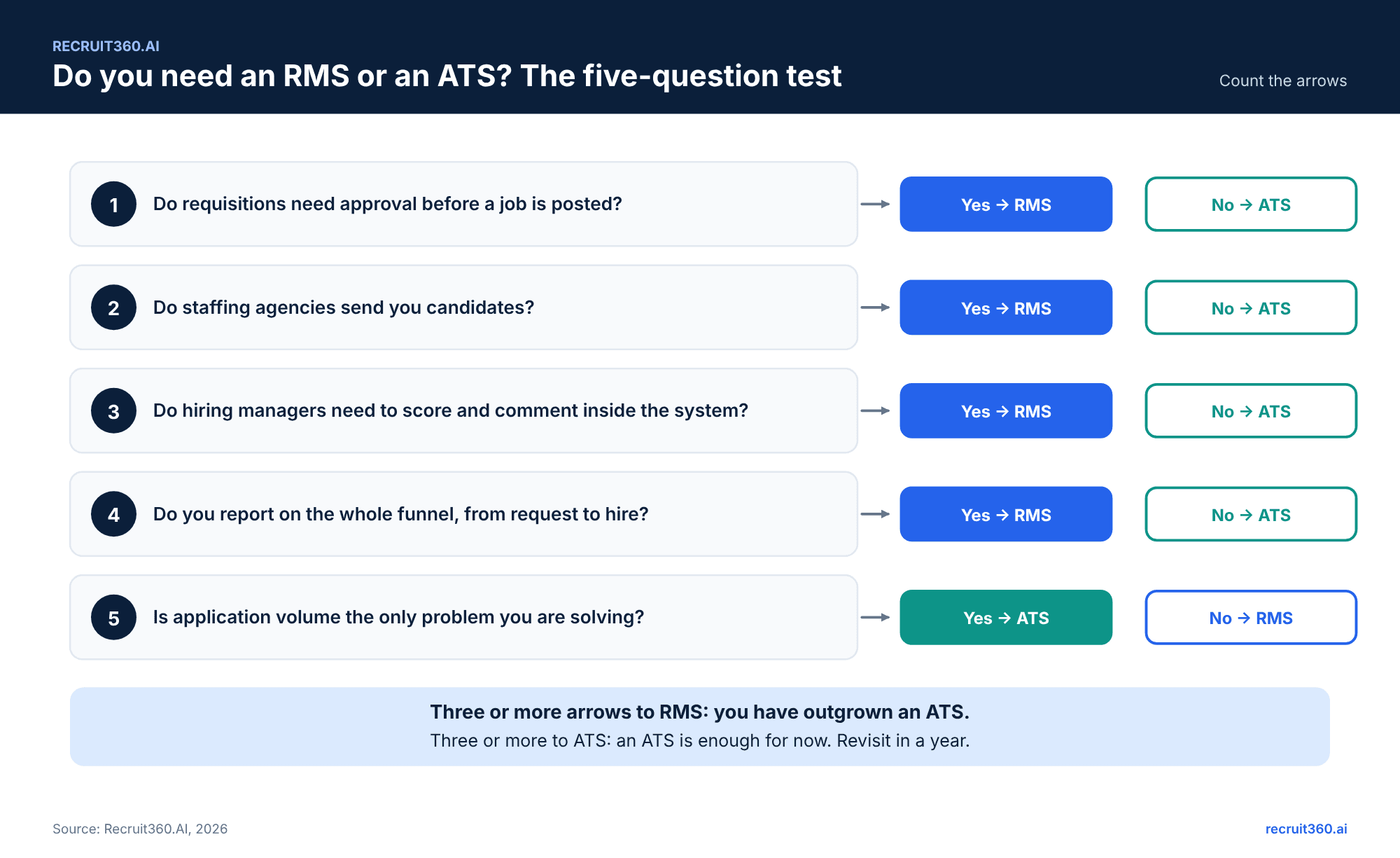 Three or more arrows to RMS and you have outgrown your ATS. Three or more to ATS and an ATS is enough for now. Check again in a year; teams that add agencies or a second office usually flip within twelve months.
Moving from an ATS to an RMS: what migrates
The move is less painful than most teams expect, because the candidate data is the part that carries over cleanly.
Candidate records, templates and stage history migrate
Candidate records, resumes, stage history and notes migrate through an export and import. Job templates and email templates usually migrate. What does not migrate is the process around the system: approval chains, agency contracts and report definitions. Those get rebuilt in the RMS, which is the point. If the process worked, you would not be moving.
What IT and HRIS admins should check before signing
Four things before the contract is signed. Single sign-on support. An API or native connector to your HRIS, so the hire flows out without re-keying. Role-based access, so agencies in the vendor portal see only their own submissions. And the data retention policy, so candidate records are deleted on the schedule your privacy team set. Recruit360.AI is SOC 2 compliant and GDPR ready, and the 15-day free trial is long enough to test all four. For pricing before you test, see recruitment software pricing in India.
Frequently asked questions
What is the difference between a recruiting CRM and an ATS?
A recruiting CRM manages prospects before they apply: pools, outreach, nurture. An ATS manages applicants after they apply: stages, interviews, compliance. The person moves from one to the other at the moment of application.
Does an RMS replace a recruiting CRM?
For most in-house teams, yes. An RMS with a talent pool keeps past candidates warm and runs the pipeline. A team whose hiring is mostly outbound sourcing may still want a dedicated CRM for campaign depth.
Can an ATS work as a CRM?
Partly. Some ATS platforms add talent pool tags and email templates. They lack campaign sequences, engagement tracking and the pool management a CRM is built for.
Do staffing agencies need a CRM or an ATS?
Both, usually in one product built for agencies. The CRM side manages candidates and clients. The ATS side tracks submissions per job. When a client uses an RMS, the agency submits through that client's vendor portal.
What is candidate relationship management?
Candidate relationship management is the practice of keeping prospective candidates engaged before a role is open, through talent pools, outreach and regular contact. A recruiting CRM is the software that runs it.
Is an RMS the same as an ATS?
No. An ATS tracks applications from apply to offer. An RMS manages the full hiring lifecycle, including requisition approval, agency submissions and funnel reporting. An RMS usually contains an ATS.
Does an RMS include an ATS?
Yes, in almost every case. The applicant pipeline inside an RMS does what a standalone ATS does. The RMS adds the stages before and after it.
Can a small company use an RMS?
Yes, and some should. A ten-person company that hires through three agencies and needs founder sign-off on every role has RMS problems at ATS scale. Pay-as-you-go pricing keeps the cost in line with the hiring volume.