

Recruitment software for companies is built around the hiring manager and the headcount plan: requisition approval, sourcing from Naukri, referrals and agencies into one pipeline, a ranked shortlist with reasons, interviews and feedback inside the system, offers with a joining date, an HRMS hand-off and analytics for the CHRO. This guide compares eight tools on those points for Indian companies.
Key takeaways:
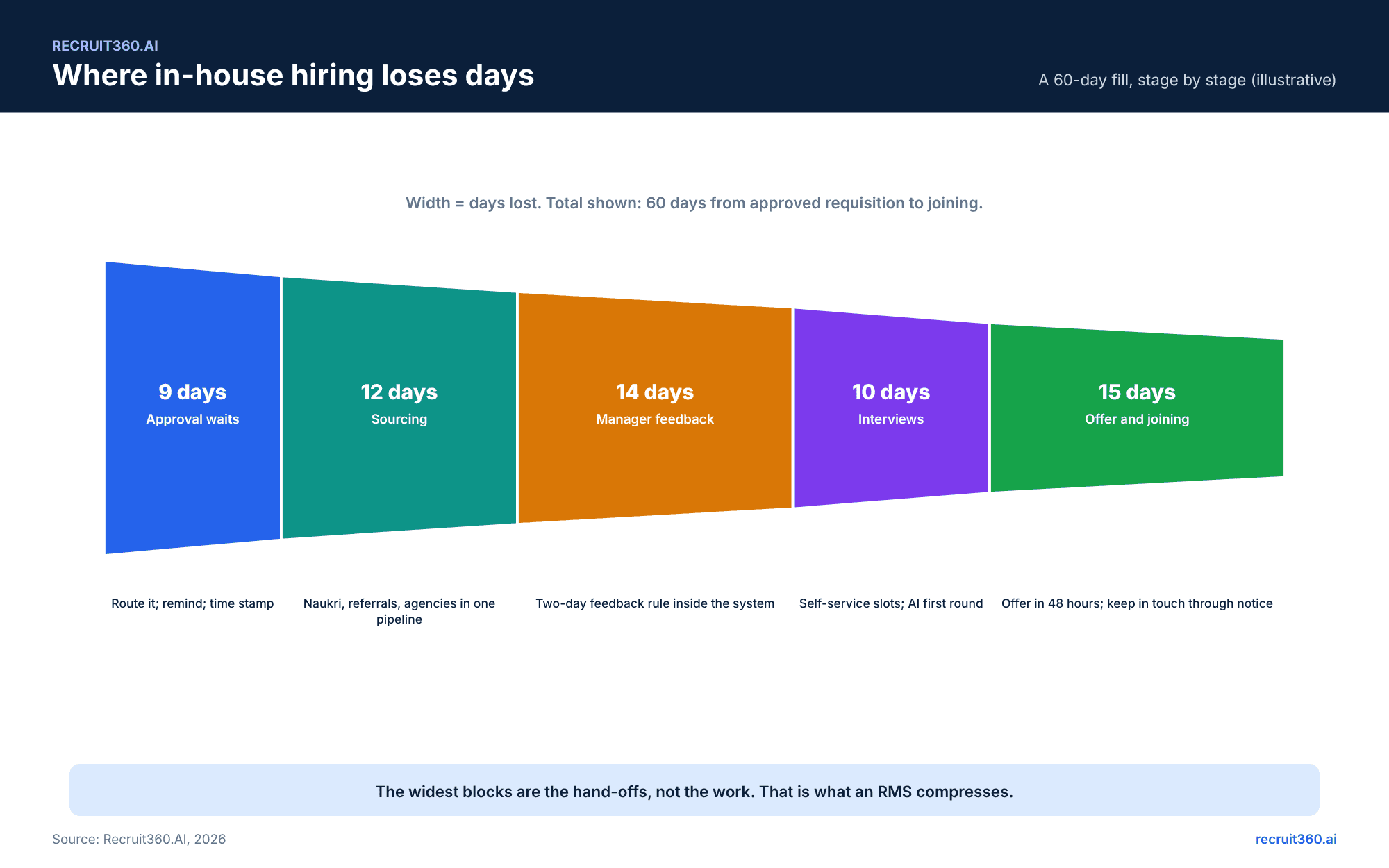
- In-house hiring loses days in hand-offs, not in sourcing. Approval and manager feedback are the two widest blocks.
- The offer-to-joining gap is India's hiring problem. Software that stops at offer accepted is measuring the wrong end.
- The tool set here is different from the staffing agency list: HRMS-linked modules, platform-fee ATS products and one AI recruitment management system.
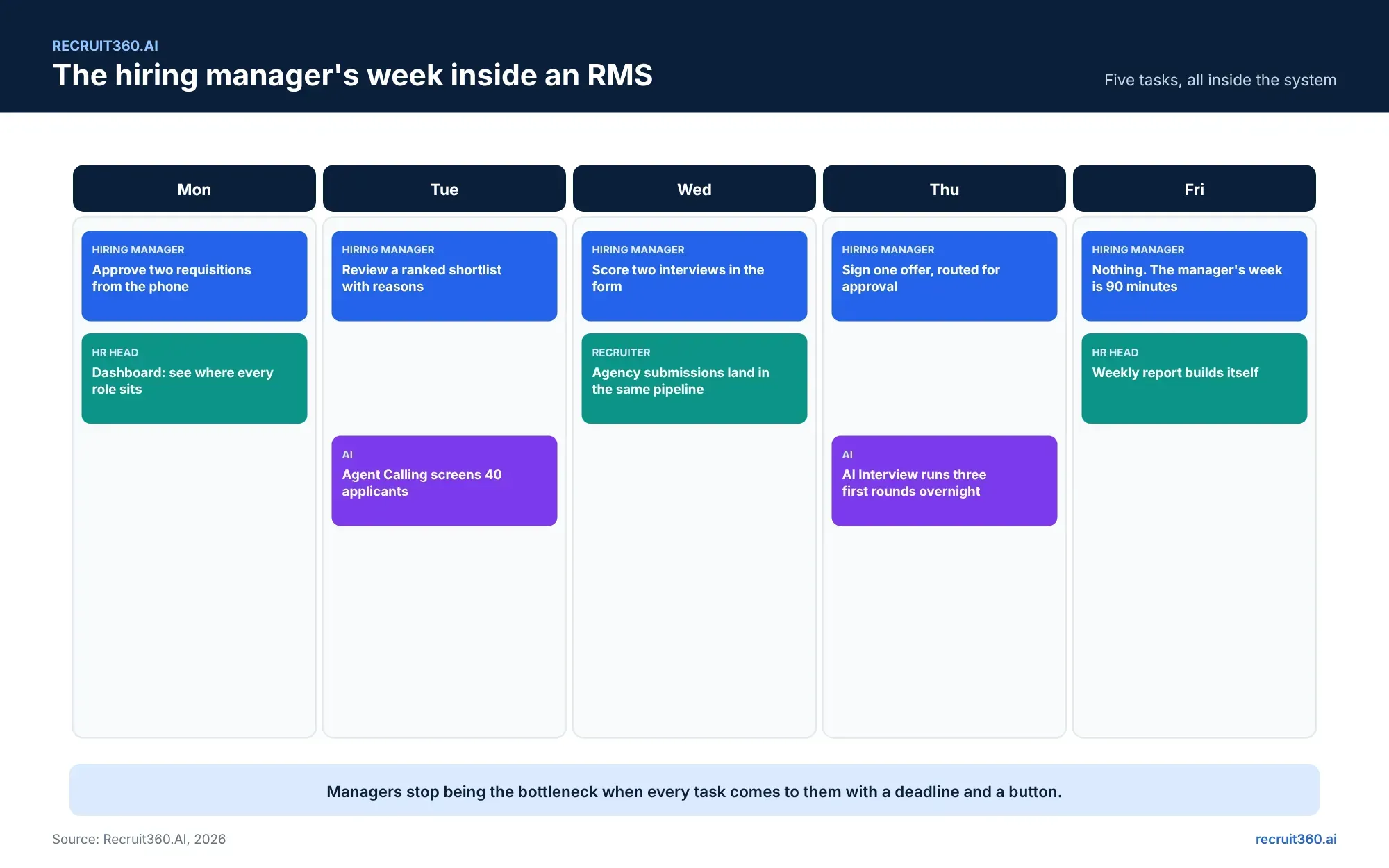
- Hiring managers do five things in a hiring process. The software should bring each one to them with a deadline and a button.
- Compare total cost at your recruiter count plus free hiring manager seats; the pricing guide has the ranges.
The pages that rank for recruitment software for companies are long roundups built for US buyers: thirteen tools with a table (Lever), eight AI tools for in-house recruiters (Collective), and a Zoho landing page with fourteen FAQs (Zoho). None addresses the Indian company's problems: Naukri as the first source, agencies on a panel, HRMS products like Keka and Darwinbox, offer drops during a 60-day notice period, and the DPDP Act. This guide does, with a different tool set from our staffing agency guide so the two do not overlap.
How in-house hiring differs from agency hiring (and why the software should too)
Headcount plans, requisition approval and budget owners
An agency opens a requirement when a client sends one. A company opens a requisition when a manager asks, finance confirms the budget, and HR checks the headcount plan. That chain can take days, and nobody measures it because it happens in email. Software built for companies starts at the request, not at the job post.
Hiring managers are the bottleneck, not sourcing
India's job market is not short of applicants. Naukri's JobSpeak index stood at 3,053 in September 2026, up 2 per cent year on year, with AI and ML roles up 20 per cent. The delay sits with the manager who has forty applicants to review, three interviews to score and a scorecard in a spreadsheet. SHRM's 2025 benchmarking puts screening and interviewing at eight to nine days each on average .
Offer drops and the joining ratio problem in India
An accepted offer in India is followed by a notice period of 30 to 90 days, and a share of candidates do not join. Indian industry estimates put offer drop at 25 to 35 per cent ; Gartner found only 48 per cent of candidates globally accepted their most recent offer in late 2025. Software that records a joining date on the offer and schedules contact through the notice period is measuring the end that matters.
What recruitment software for companies must do
Requisition and approval workflow tied to the headcount plan
A manager raises a requisition against a budget line. Approvers sign off in order, with reminders, and the job opens the moment the last approval lands. The days between request and approval are time-stamped and reported.
Sourcing from Naukri, LinkedIn, referrals and campus in one pipeline
One approved requisition posts to Naukri and LinkedIn, opens the referral form to employees, and reaches the agency panel through a vendor portal. Campus drives in December and January run through the same pipeline with the same scorecards. Every candidate carries a source.
AI matching and ranked shortlists for hiring managers
The manager opens a ranked list, not an inbox, with a reason beside each name and the must-haves they wrote marked as met or missing. They can override and the override is logged. The AI recruitment management system guide explains the four layers.
Interview scheduling, AI interviews and feedback inside the system
Self-service slots, calendar sync, a structured scorecard the panel fills in the system, and an AI first round for volume roles with a recruiter reviewing every result. Feedback that lives in the system can be measured; feedback in email cannot.
Offer management, background verification and HRMS hand-off
The offer is approved in the same workflow as the requisition, carries a joining date, triggers the background check with consent, and pushes the hire into the HRMS with no re-keying.
Recruitment analytics for the CHRO
Time to fill by department, cost per hire, source of hire, offer acceptance, joining ratio and hiring manager response time, on one page, without an export. The recruitment metrics guide gives the formulas.
Recruitment software for companies at a glance
Every price below was read on 15 October 2026 from the vendor's own page or a named listing and excludes GST; a vendor that quotes only on request is marked not published.
| Tool | Best for | Company size | Pricing (Oct 2026) | HRMS link | AI | Free trial |
|---|---|---|---|---|---|---|
| Recruit360.AI | Companies with approval chains and agency panels | 50 to 5,000 employees | Pay as you go | API and connectors | Profile Recommendation Engine, AI Interview, Agent Calling | 15 days, no card |
| Keka Hire | Keka HR customers | SME to mid-market | 999 to 2,999 rupees per month by active jobs | Native to Keka | CV to JD match, AI screening interviews | Yes |
| Darwinbox Recruit | Enterprises on Darwinbox | Large | Not published | Native to Darwinbox | AI job match score, WhatsApp alerts, voicebot | Demo |
| greytHR Recruit | SMEs on greytHR | Small to mid | 2,500 rupees per recruiter per month add-on | Native to greytHR | Match score, pre-screening bot | Core 7-day trial |
| Workable | Fast setup, many hiring managers | 20 to 1,000 plus | $299 to $719 per month platform fee by headcount | Integrations | Workable Agent, credit add-on | 15 days, no card |
| factoHR | Companies on factoHR payroll | Small to mid | $75 per recruiter per month add-on | Native to factoHR | Chatbot add-on | Free HR plan to 20 employees |
| Zoho Recruit | Budget-first teams | Small | About $30 per user per month (help docs); INR via partners | Zoho People | Zia on Enterprise | 15 days, then free plan |
| Greenhouse | Structured hiring at scale | Mid to enterprise | Not published | Integrations | AI Notetaker, talent matching | No |
How we compared recruitment software for companies
Seven criteria, scored from each vendor's public documentation on 15 October 2026 and from demos we have run: approval workflow tied to a headcount plan, Naukri and referral sourcing without a partner key, an agency portal, an AI shortlist that shows a reason, offer to joining workflow with a joining date, the HRMS hand-off, and pricing with free hiring manager seats. No user survey; no estimated prices. The tool set was chosen to differ from our staffing agency guide so the two pages answer different questions.
The 8 best recruitment software tools for companies in India
1. Recruit360.AI: best for companies with approval chains and agency panels
Disclosure: this is our product. Best for: companies from fifty to several thousand employees whose hiring runs through managers, finance and an agency panel. What it does: requisition and approval routing tied to the headcount plan; the Profile Recommendation Engine, which parses, matches on meaning, scores against the manager's must-haves and ranks with a reason; a vendor portal for the agency panel with duplicate checks; Agent Calling and AI Interview for the first round; self-service scheduling and scorecards; offers with a joining date and WhatsApp check-ins through the notice period; an HRMS hand-off by API; and a CHRO dashboard. Watch for: a smaller integration catalogue than the HRMS suites; check your payroll connector on the demo. Pricing: pay as you go, with hiring managers and interviewers free; 15-day trial, no card.
2. Keka Hire: best for Keka HR customers
Best for: companies already running Keka for payroll and HR. What it does: posts jobs, scores each CV against the JD on the Advanced plan, runs AI screening interviews that leave a transcript, schedules interviews, and hands the hire straight into Keka's employee records (Keka Hire). Watch for: no agency vendor portal, and approval workflow is lighter than a dedicated RMS. Pricing: by active job count, from 999 rupees a month.
3. Darwinbox Recruit: best for enterprises on Darwinbox
Best for: large companies that run Darwinbox as the HCM. What it does: an AI job match score, AI scoring and recommendations, WhatsApp alerts and a voicebot for candidates, job board integrations, and the native link to Darwinbox onboarding. Watch for: no vendor portal mentioned on the product page; pricing is not published and implementation is enterprise-scale.
4. greytHR Recruit: best for SMEs on greytHR
Best for: small and mid-sized companies on greytHR payroll. What it does: one-click posting to Naukri, LinkedIn, Hirist and IIMJobs, an AI match score out of 100, a pre-screening bot, and NAVOS AI for job descriptions and emails. Watch for: an add-on rather than a standalone product; no vendor portal. Pricing: 2,500 rupees per recruiter per month.
5. Workable: best for fast setup
Best for: companies with many hiring managers and a small recruiting team. What it does: posting to 200 or more boards, a platform fee by headcount with unlimited users, an AI agent that screens against up to fourteen criteria on credits, and a built-in HR suite. Watch for: dollar pricing, AI as a metered add-on, no agency portal. Pricing: $299, $599 or $719 a month by band.
6. factoHR: best for companies on factoHR payroll
Best for: small and mid-sized companies on factoHR. What it does: a recruitment add-on to the HR suite at $75 per recruiter per month, with a free core HR plan for companies up to twenty employees. Watch for: recruitment AI is not detailed on the pricing page, and there is no agency portal.
7. Zoho Recruit: best for budget-first teams
Best for: small teams that need an ATS now and may move later. What it does: a free plan with one active job per recruiter licence, Zia matching on Enterprise, Naukri posting through a Zwayam key, and a link to Zoho People. Watch for: approvals need Blueprint setup; the vendor portal is an add-on. Pricing: Zoho's help documentation lists $30 and $60 per user per month; INR via partners. See Zoho Recruit alternatives when you reach the first agency or the first approval chain.
8. Greenhouse: best for structured hiring at scale
Best for: mid-market and enterprise companies that want a repeatable, structured process. What it does: interview plans and scorecards, AI Notetaker and talent matching in every plan, fraud detection, and hundreds of integrations. Watch for: pricing on request, no free trial, dollar billing, and no Naukri-first sourcing. Our global AI tools list covers it in more depth.
In-house recruitment software vs an ATS vs an HRMS recruiting module
An ATS tracks applications from apply to offer and suits a team with one recruiter and no approvals. An HRMS recruiting module, such as Keka Hire or Darwinbox Recruit, lives inside the payroll system and suits a company that wants one vendor and has simple hiring. A recruitment management system covers requisition approval, agencies, AI screening, offers and joining, and reporting, and suits a company whose hiring involves managers, finance and a panel. RMS vs ATS vs recruiting CRM sets out the differences in full. The test: if any of your delays sit before the job post or after the offer, you need the RMS.
Why Recruit360.AI is the recruitment software for your company
The HRMS modules on this list are good at the hand-off and light on the hiring. The global ATS products are good at the pipeline and blind to Naukri, agencies and the notice period. Recruit360.AI was built for the company in the middle: an approval chain that starts at the headcount plan, a manager who gets a ranked shortlist with reasons and a scorecard with a deadline, an agency panel that submits through a portal, a first round run by Agent Calling and AI Interview with a recruiter reviewing every result, an offer that carries a joining date and WhatsApp check-ins through the notice period, and a dashboard the CHRO can read on Monday. Hiring managers are free users, pricing is pay as you go, and the trial runs on a live requisition with your own approvers.
Frequently asked questions
What is recruitment software for companies?
Software an in-house hiring team uses to run requisitions and approvals, source from job boards, referrals and agencies, screen and rank candidates, schedule interviews and collect feedback, manage offers through to joining, hand the hire to the HRMS, and report on all of it.
What is the difference between in-house recruitment software and an ATS?
An ATS tracks applications from apply to offer. In-house recruitment software, or a recruitment management system, also covers the approval chain before the job post, the agency panel, the offer and joining stage, and the HRMS hand-off.
Which recruitment software is best for companies in India?
It depends on your HRMS and your hiring complexity. Keka Hire, Darwinbox Recruit and greytHR Recruit suit companies already on those suites with simple hiring. Recruit360.AI suits companies with approval chains, agency panels and volume screening. Workable suits fast setup with many managers.
Should we use our HRMS's recruiting module?
If hiring is simple and the HRMS link matters most, yes. If approvals, agencies, AI screening and the offer-to-joining gap are where you lose time, a dedicated recruitment management system with an HRMS connector does more.
How do we reduce offer drops?
Record a joining date on every offer, keep in touch through the notice period on WhatsApp, have the manager message the candidate a week before joining, and measure joining ratio, not just offer acceptance. Indian industry estimates put offer drop at 25 to 35 per cent.
How do we get hiring managers to give feedback faster?
Put the scorecard inside the system with a two-day deadline and a reminder, send the ranked shortlist with reasons so review takes minutes, and report response time by manager monthly.
Does recruitment software handle campus hiring?
It should. Campus drives run through the same pipeline with bulk upload, the same scorecards and the same offer workflow, so December and January hiring is reported alongside the rest.
Are hiring managers charged as users?
On most per-seat tools, no, or at a reduced rate; on platform-fee tools such as Workable and pay-as-you-go tools such as Recruit360.AI, never. Ask, because a company with sixty hiring managers and four recruiters can pay more for managers than for recruiters on the wrong model. The pricing guide covers the four models.
In-house vs agency hiring software — what's the difference?
Agency software optimises many clients and submissions; in-house software optimises requisition approvals, hiring-manager workflow and offer management. Recruit360.AI does both, with a vendor portal for the agencies you work with.
How long does the HRMS hand-off take to set up?
Days when the recruiting module is native to the HRMS, as with Keka Hire or Darwinbox Recruit. One to three weeks for a dedicated recruitment management system connecting by API, most of it spent agreeing which fields map to which. Ask to see the field mapping on the demo rather than taking the word "integration" on trust.