

A vendor management system for recruitment is a portal where staffing agencies log in, see the requisitions you have shared with them, and submit candidates. The system records which agency sent each person and when, flags duplicates, sends status and feedback back to the agency, and reports on how each agency performs. It replaces the email threads and spreadsheets most teams use to manage agency hiring today.
Key takeaways:
- Agency hiring breaks in three places: duplicate submissions, lost feedback, and no data on who delivers. A vendor portal fixes all three.
- A recruitment VMS is not the same as a contingent-workforce VMS. One manages candidate submissions. The other manages contractor hours and invoices.
- The metrics it unlocks are submission-to-interview rate, time to submit and fill rate by agency.
- You can buy a standalone VMS or use the vendor portal inside a recruitment management system. The second option keeps agency candidates in the same pipeline as everyone else.
Ask a recruiter how agency candidates arrive and the answer is almost always "by email". A PDF of the job goes out to six agencies. Resumes come back as attachments. Someone copies each one into the system, or does not. When two agencies send the same person a day apart, the argument about ownership lasts longer than the interview. This post explains what a vendor management system does in recruitment, how a vendor portal works step by step, and how to decide between a standalone VMS and the portal built into your recruitment management system.
What a vendor management system does in recruitment
In recruiting, a vendor is a staffing agency, a search firm or a recruitment process outsourcer that sends you candidates. A vendor management system is the place where that relationship runs. Zoho describes it as a platform that "allows staffing agencies to submit talent to clients for review in a streamlined fashion" (Zoho Recruit). JobAdder calls the same thing an agency portal: hiring companies post jobs to it and pick which agencies can submit (JobAdder).
Recruitment VMS vs contingent-workforce VMS (not the same thing)
Two products share the name. A contingent-workforce VMS, such as SAP Fieldglass or Beeline, manages contractors after they start: timesheets, rates, invoices, compliance. A recruitment VMS manages the step before: agencies submitting candidates for permanent and contract roles. This post is about the second one. If your procurement team already runs a contingent VMS, you still need a recruitment vendor portal for permanent hiring, and the two can hand off to each other.
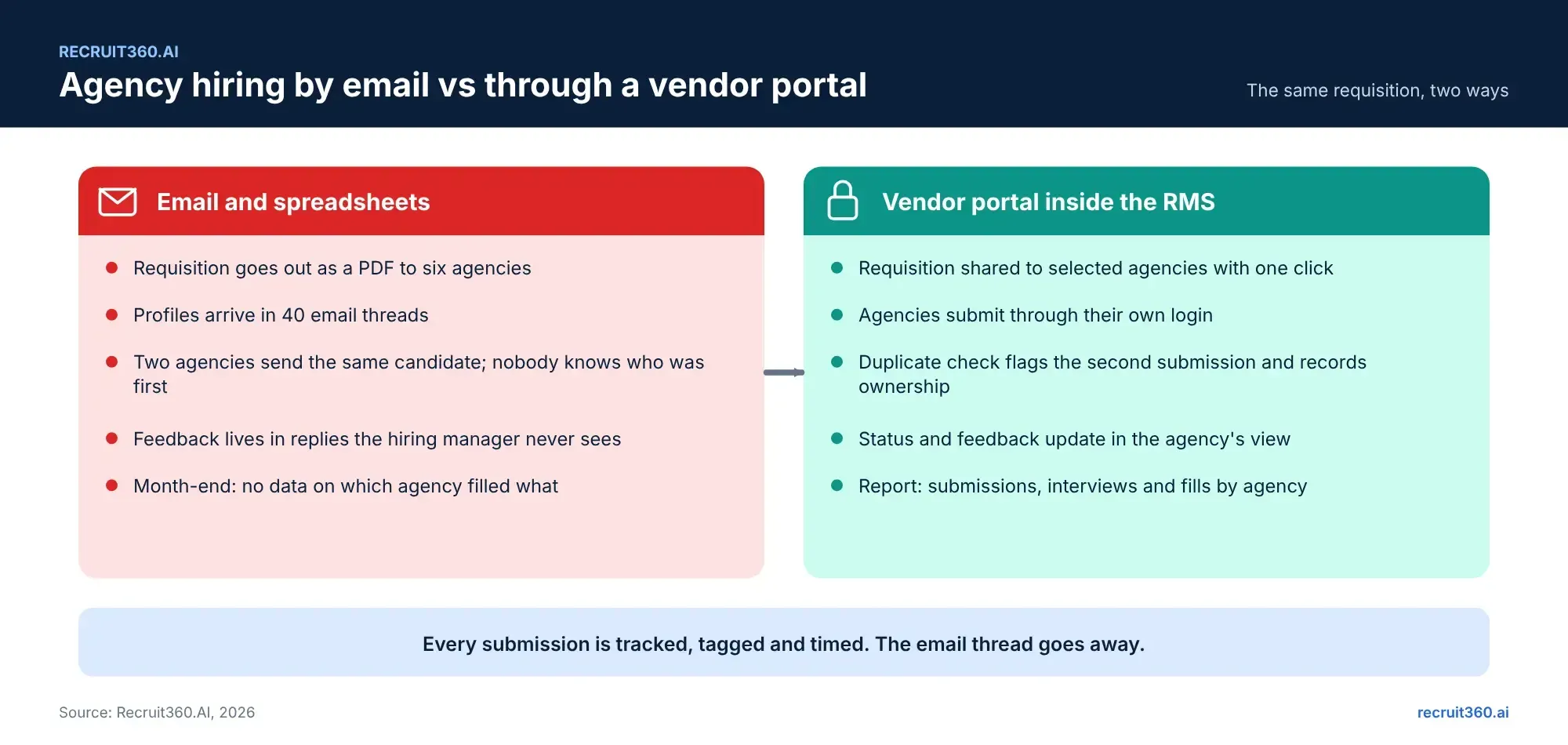
| Email and spreadsheets | Vendor portal | |
|---|---|---|
| Submission | Attachment in an email thread | Upload through the agency's own login, against a named requisition |
| Duplicate check | Manual, if anyone remembers | Automatic, with the first-submitted agency recorded as owner |
| Status visibility | Agency asks; recruiter replies when free | Agency sees stage changes in their view |
| Feedback loop | Lost in replies the hiring manager never sees | Feedback on the candidate record flows to the agency |
| Reporting | None, or a spreadsheet built by hand | Submissions, interviews and fills by agency, on a dashboard |
| Audit trail | Email search | Timestamped log of every action |
Onboarding vendors: agreements, contacts, tiers and sourcing limits
Before any requisition is shared, each agency is set up once: the signed agreement, the fee terms, the recruiter contacts, and the tier they sit in. Tier one agencies see every role on day one. Tier two agencies see a role only if tier one has not filled it in a set number of days. The portal holds this so nobody has to remember it.
Agencies comparing tools can start with our list of the best recruitment software for staffing agencies in India.
Controlling sourcing: who may submit to which requisition
Not every agency should see every role. A confidential replacement goes to one search firm. A high-volume contract role goes to the whole panel. The recruiter sets this per requisition, and an agency that was not invited cannot submit. That one control ends most ownership disputes before they start.
IT staffing firms that run a bench have extra needs, covered in our guide to recruitment software for IT staffing and bench sales.
How agency hiring breaks without a vendor portal: duplicates, lost feedback and no data
Duplicate submissions and ownership disputes
The same candidate reaches two agencies. Both send the profile. Whoever gets the fee depends on who can prove they sent it first, and the proof is an email timestamp someone has to find. Agencies know this and send fast, which means they send before they have screened.
Lost feedback and slow responses
A hiring manager rejects a candidate in a chat message to the recruiter. The recruiter means to tell the agency. Two weeks later the agency sends three more people with the same gap. The feedback existed; it never reached the person who needed it.
No data on which agency delivers
At the end of the quarter, the talent acquisition leader wants to cut the agency list from eight to four. The question is simple: who fills roles, and how fast? Without a portal, the answer takes a recruiter a day of searching email. With one, it is a report.
How a vendor management portal works
Six steps, two sides. Your team works in the recruitment management system. The agency works in the portal. The portal is the boundary between them.
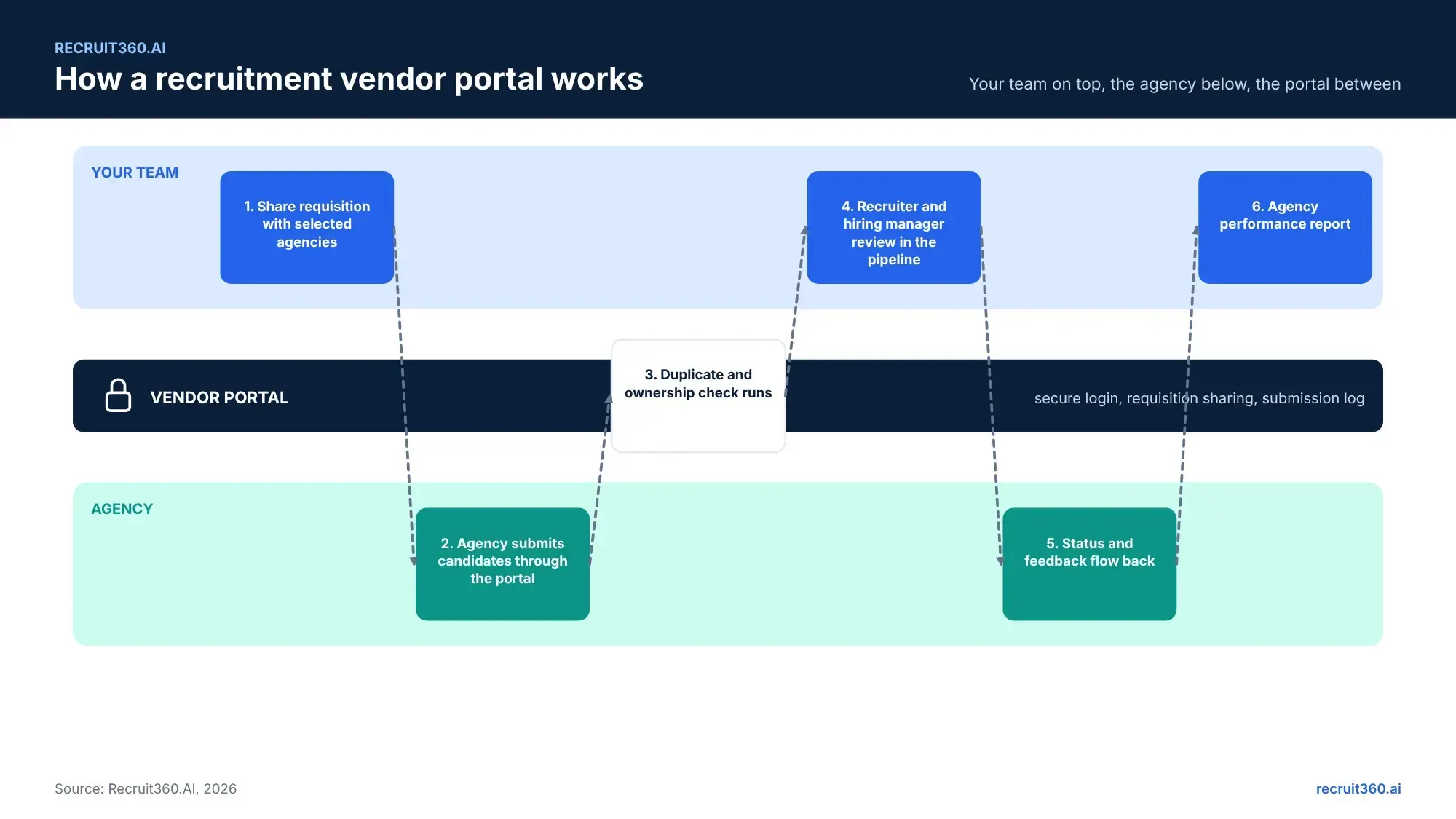
1. Share a requisition with selected agencies
The recruiter opens an approved requisition and picks which agencies can see it. Some roles go to one specialist firm, some to a panel of five. The agency gets a notification and the role appears in its portal view, with the job description, location, salary band and the submission deadline.
2. Agencies submit candidates through the portal
The agency uploads a resume and a short note against the requisition. No email. The submission carries the agency's name, the recruiter who sent it and a timestamp. The candidate record is created in your system at that moment, tagged with the source.
3. Automatic duplicate and ownership checks
Before the submission lands, the system checks the candidate against every record you hold: direct applicants, other agency submissions, past candidates. If the person is already there, the second agency sees a message and the first submitter keeps ownership. The rule is yours to set: 90 days, 180 days, or the length of your agency agreement.
4. Recruiters and hiring managers review in the same pipeline
Agency candidates sit in the same pipeline as direct applicants, with the same AI match score and the same stages. The hiring manager scores the interview on the record. Nobody asks which inbox the resume came from.
5. Status and feedback flow back to the agency
When a candidate moves stage, the agency sees it. When a hiring manager rejects with a reason, that reason reaches the agency through the portal. The next three candidates from that agency are better because the feedback arrived.
6. Agency performance reporting
Every submission, interview and hire is timestamped and tagged. The report at quarter end builds itself: submissions per agency, how many reached interview, how many were hired, and how long each took.
Metrics a recruitment VMS unlocks: submission-to-interview rate, fill rate and cost per agency hire
Three numbers tell you which agencies to keep. None of them exist without a portal.
Submission-to-interview rate by agency
Of the candidates an agency sends, how many does a hiring manager want to meet? A low rate means the agency is sending volume, not fit. A high rate means they understood the brief.
Fill rate and time to submit
Fill rate is the share of roles an agency was given that it filled. Time to submit is the days between the requisition being shared and the first candidate arriving. An agency with a fast time to submit and a low fill rate is sending before screening.
Cost per agency hire
Fee divided by hires, per agency, per quarter. Combined with time to fill, this is the number that decides the agency panel for next year.
What a vendor management system means for each role
Corporate recruiters
You stop being the post office. Agency candidates land in your pipeline tagged and de-duplicated. You spend the time on the ones worth a call. When an agency asks for an update, they already have it.
Hiring managers
You see one shortlist, not one per agency. You score candidates the same way whether they came from an agency or the careers page. Your rejection reasons reach the agency without a second conversation.
HR and talent acquisition leaders
You get the agency scorecard every quarter without asking anyone to build it. You negotiate fees with fill-rate data in hand. You cut the panel with evidence.
IT and HRIS admins
Agencies get a scoped login to the portal, not an account in your core system. Role-based access means an agency sees its own submissions and nothing else. Candidate data stays inside one platform with one retention policy.
Standalone VMS or vendor portal inside your RMS?
When a standalone VMS makes sense
You run a large contingent workforce with hundreds of contractors, and procurement owns the relationship. Timesheets, rate cards and invoicing matter more than candidate screening. A dedicated contingent-workforce VMS, integrated to your RMS for the hiring step, is the right shape.
When the portal belongs in the RMS
You hire permanent and contract staff through agencies and you want agency candidates in the same pipeline as everyone else, with the same AI screening and the same reporting. A vendor portal inside a recruitment management system does that without a second system to integrate. This is how the Recruit360.AI vendor portal works: agencies submit through their login, and the candidate lands in the pipeline with a source tag and a match score.
For the agency side of the same workflow, read how staffing agencies manage multiple client requirements without dropping one.
7 questions to ask a VMS vendor
- Does each agency get its own login, scoped to the requisitions I share with them?
- How does the duplicate check work, and can I set the ownership window?
- Do agency candidates sit in the same pipeline as direct applicants, with the same scoring?
- Does hiring manager feedback reach the agency automatically, or does a recruiter relay it?
- Which agency performance reports exist out of the box?
- Can the portal hand a hired contractor to a contingent-workforce VMS or the HRIS?
- Is there a per-agency fee, or is the portal included in the platform price?
Frequently asked questions
What is a vendor management system in recruitment?
It is a portal where staffing agencies see the requisitions you share with them and submit candidates. The system tags each submission by agency, checks for duplicates, sends status back to the agency and reports on agency performance.
What is the difference between a VMS and an ATS?
An ATS tracks all applicants through your pipeline. A recruitment VMS manages the agencies that send some of those applicants. Inside a recruitment management system, the vendor portal feeds the same pipeline the ATS functions track.
Do staffing agencies need to buy software to use a vendor portal?
No. The agency logs in to your portal with a browser. They keep their own ATS or CRM for their candidates and submit to you through the portal.
How does a vendor portal prevent duplicate candidates?
When an agency submits, the system matches the candidate against every record you hold, by email, phone and name. If the person exists, the second submission is flagged and the first submitter keeps ownership for the window you set.
Is a recruitment VMS the same as a contingent workforce VMS?
No. A contingent-workforce VMS manages contractors after they start: hours, rates, invoices. A recruitment VMS manages agencies submitting candidates before the hire. Many companies run both, connected.