

Recruitment software for IT staffing is a recruitment management system built for two pipelines at once: client requirements coming in, and consultants going out. The features that separate it from a corporate ATS are a bench and hotlist, consultant marketing by mass email, a vendor database with tiers, submission tracking within client limits, duplicate checks across vendors, and the paperwork for C2C, W2 and 1099 placements through to timesheets and invoices. This guide compares eight tools on those features and explains the vocabulary.
Key takeaways:
- IT staffing runs two pipelines. Software built for one of them will lose requirements or lose consultants.
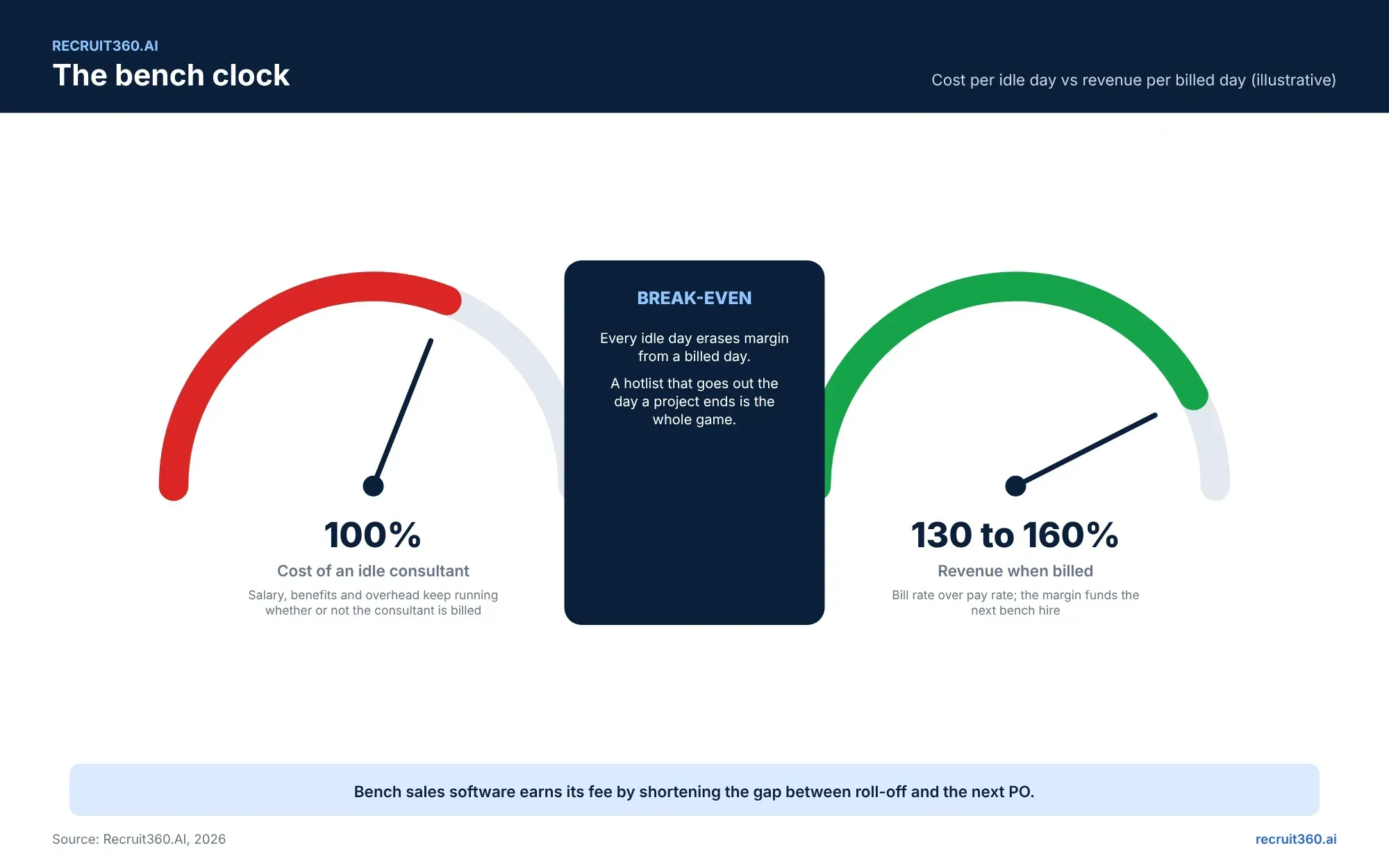
- The bench is a cost until the next purchase order. The hotlist is how you shorten the gap.
- Duplicate submissions across vendors cost more than a missed requirement. The check has to be automatic.
- The best tool depends on which pipeline hurts: requirement intake, bench marketing, or vendor portal submissions.
- Recruit360.AI is on the list, with a disclosure. The scorecard at the end works on any of the eight.
Search for bench sales software and you get product pages, not guides. Conrep's page explains the bench vocabulary well in its FAQ (Conrep); TheHireHub's roundup covers IT services hiring in India but not the bench (TheHireHub). Nothing compares the tools side by side on the features IT staffing firms use every day. This guide does that: what makes IT staffing different, the workflow from requirement to invoice, the must-have features, eight tools compared, and a glossary for anyone new to C2C, prime vendors and hotlists.
Why IT staffing and bench sales need different recruitment software
A corporate recruiter fills one company's roles. An IT staffing firm fills many clients' requirements, often through other vendors, with consultants it may already employ. The software has to hold both sides.
Two pipelines: requirements in, consultants out
Requirements arrive by email from clients, prime vendors and vendor management systems, sometimes fifty in a day across a team. Each one needs parsing, logging, allocation and a decision: do we have someone on the bench, or do we source? Consultants go out the other way: marketed to vendors, submitted within limits, interviewed, placed, billed. A tool that tracks candidates but not requirements, or requirements but not the bench, leaves half the business in a spreadsheet.
The bench: who is on it, when they roll off, what they cost
The bench is the set of consultants the firm employs who are not currently billed to a client. Each has a skill set, a location, a work authorisation status, a rate expectation, and a roll-off date from their current project. The firm pays them while they sit. Bench sales is the function that markets them to vendors and clients before the roll-off date arrives. Software that cannot show the bench by roll-off date cannot do bench sales.
Vendor tiers, prime vendors and the VMS layer
Large clients buy IT staffing through a prime vendor or a vendor management system such as Fieldglass or Beeline. Smaller firms submit to the prime vendor as a tier-2 supplier. Each layer has its own submission limits, rate caps and paperwork, and each layer can send the same requirement to many suppliers. The vendor database tracks which vendor sends which requirements, pays on time, and which has already seen a given consultant.
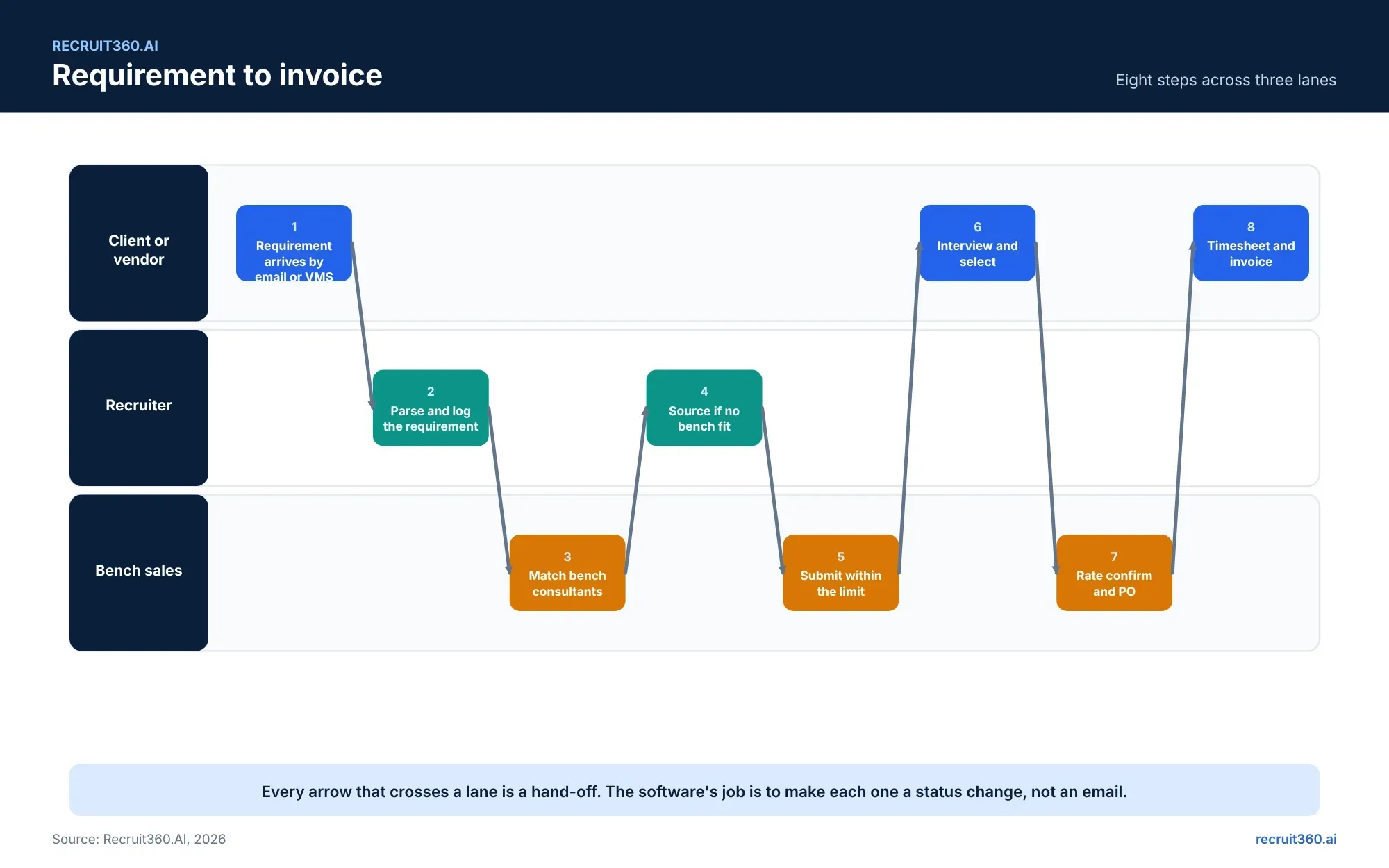
The IT staffing workflow from requirement to invoice (eight steps)
- A requirement arrives by email or through a VMS portal.
- It is parsed and logged: skills, rate, location, duration, work authorisation, submission limit, deadline.
- The bench is matched against it. A consultant on the bench with the right skills is the first candidate.
- If no bench fit, the recruiter sources from the database, Dice, Monster, LinkedIn and referrals.
- The best profiles are submitted within the limit, with a right-to-represent and a time stamp.
- The client interviews and selects.
- The rate is confirmed and the purchase order arrives.
- The consultant starts, timesheets are submitted, and the invoice goes out on the agreed cycle.
Every arrow between steps is a hand-off between a client or vendor, a recruiter and a bench sales executive. The software's job is to make each one a status change rather than an email thread. Our guide on how staffing agencies manage multiple client requirements covers the hand-offs in detail.
Must-have features in bench sales and IT staffing software
Hotlist management and consultant marketing (mass email that does not get you blocked)
A hotlist is the list of available consultants, with skills, location, availability date and rate, sent to vendors to generate requirements. The software builds it from the bench automatically, formats it for email, sends it to vendor contacts in batches that stay under mail-provider limits, tracks opens and replies, and stops sending to anyone who asks to be removed.
Vendor database and requirement intake from email
Every vendor contact, the requirements they have sent, the submissions made to them, the placements and the payment history, in one record. Requirements that arrive by email are parsed into fields rather than forwarded, so they land on the board the moment they arrive.
Duplicate submission checks across vendors
The same consultant submitted to the same end client by two vendors is the fastest way to lose both. The check runs on every submission against every previous submission, by name, email, phone and end client, and warns before the submission goes out.
Submission, interview and placement tracking
Each submission carries the requirement, the vendor, the rate, the right-to-represent and the time stamp. Interviews, feedback and offers attach to it. Placements convert it into a project record with a start date, a bill rate and a pay rate.
Timesheets, invoicing and C2C vs W2 paperwork
A consultant can be placed on W2 (the firm's employee), C2C (through the consultant's own corporation), or 1099 (independent contractor). Each has different documents, tax treatment and margin. The software holds the paperwork, collects timesheets, and raises invoices from approved hours.
AI matching of consultants to requirements
Fifty requirements a day cannot be matched by hand. AI matching reads each requirement, scores the bench and the database against it on meaning rather than keywords, and ranks with a reason beside each name. A recruiter reviews the ranking and submits. The guide to AI resume screening explains the four steps.
Best recruitment software for IT staffing at a glance
Prices are from each vendor's public pricing page or a named third-party listing on 15 October 2026, before GST, and change often. "Not published" means a quote on request only.
| Tool | Best for | Hotlist and bench | Vendor database | VMS | Timesheets and invoicing | Pricing (Oct 2026) |
|---|---|---|---|---|---|---|
| Recruit360.AI | Firms that submit through client vendor portals | Bench view and AI matching to requirements | Yes, with tiers | Vendor portal built in | Placement record; invoicing via integration | Pay as you go; 15-day free trial |
| Ceipal | US-India firms that want one suite | Talent Bench module, hotlist sharing | Yes | Own VMS product; 16 VMS integrations incl. SAP Fieldglass | Yes | Not published; Capterra lists $25 per user per month |
| JobDiva | Large US staffing firms | Not described on public pages; confirm on demo | Yes | DivaVMS and VMS synchronisation | Contractor timesheet app | Not published |
| Oorwin | Bench marketing | Bench Sales Manager with hotlist campaigns and Job Grabber | Yes | Via integrations | Partial | Not published by vendor; Capterra lists from $25 per user per month |
| Conrep | Bench to billable tracking | Bench Sales and Training module with hotlist management | Yes | VMS module | Timesheets and expenses; immigration module | From $98 per month (Starter, unlimited users) or from $20 per user per month |
| Bullhorn | Enterprise staffing, US and UK | Via Bullhorn One and partners | Yes | Via VMS partners | Bullhorn One back office | Starter $99, Core $165 per user per month; AI from Pro |
| Zoho Recruit (Staffing edition) | Small IT staffing firms on a budget | No bench module | Vendor portal add-on | No | No | Standard about $30 per user per month per Zoho help docs; INR via partners |
| Recruiterflow | Firms that run outbound sales to vendors | No bench module; AIRA sourcing agents | CRM-style | No | No | Platform plan $149 per user per month |
How we compared the eight
Six criteria, each scored from the vendor's public documentation and the demo: requirement intake, bench and hotlist, vendor database and VMS, duplicate checks, placement to billing, and pricing fit for a 10 to 50 recruiter firm. We did not run a user survey. Where a vendor publishes no price, we say so rather than estimate.
The 8 best tools for IT staffing and bench sales
1. Recruit360.AI: best for firms that submit through client vendor portals
Disclosure: this is our product. Best for: IT staffing firms whose clients run vendor portals and whose requirements arrive from prime vendors. What it does: requirement intake onto one board, AI matching of the bench and database to each requirement with a reason per name, a vendor portal with submission limits and duplicate checks across every submission, Agent Calling to confirm consultant availability and rate before a submission, and analytics by vendor and client. Watch for: timesheets and invoicing run through an integration rather than a native module; check your accounting connector on the demo. Pricing: pay as you go; 15-day free trial with no credit card. See the AI recruitment management system guide for how the matching works.
2. Ceipal: best for US-India firms that want everything in one suite
Best for: firms that want ATS, bench, VMS and workforce management from one vendor. What it does: a Talent Bench module with hotlist sharing and submission of bench applicants to vendors, a VMS product with timesheets and vendor scorecards, and integrations with Dice, Monster, Naukri and sixteen vendor management systems including SAP Fieldglass (Ceipal integrations). Watch for: the suite is wide, so configuration takes time, and the price is on request. If you are already on it and looking elsewhere, read Ceipal alternatives for IT staffing firms.
3. JobDiva: best for large US staffing firms
Best for: firms with hundreds of recruiters and VMS-heavy clients. What it does: its own vendor management system, DivaVMS, with supplier submissions and contractor timekeeping, plus VMS synchronisation into the ATS (JobDiva). Watch for: bench and hotlist features are not described on its public pages, so ask on the demo; pricing is not published.
4. Oorwin: best for bench marketing
Best for: bench sales teams whose job is hotlist campaigns. What it does: a Bench Sales Manager with targeted hotlist campaigns, a Job Grabber that pulls matching requirements from job boards, and AI talent matching for the bench (Oorwin). Watch for: the vendor's own pricing page was unreachable at the time of writing; third-party listings show from $25 per user per month.
5. Conrep: best for bench to billable tracking
Best for: firms that want the bench, timesheets and immigration paperwork in one place. What it does: a Bench Sales and Training module with hotlist management, timesheets and expenses, a VMS module, and an immigration module for visas and petitions (Conrep modules). Watch for: it is a back-office system first; recruiter-facing sourcing is lighter than the others. Pricing: from $98 per month on an annual plan or from $20 per user per month (Conrep pricing).
6. Bullhorn: best for enterprise staffing
Best for: large agencies with global clients. What it does: the industry standard ATS and CRM with back office in Bullhorn One; AI search and match from the Pro tier up (Bullhorn pricing). Watch for: bench and VMS work run through partners, and the per-user price is the highest on this list. Pricing: small-agency plans at $99 (Starter) and $165 (Core) per user per month; Pro and above on quote.
7. Zoho Recruit: best for small IT staffing firms on a budget
Best for: firms under ten recruiters that need an ATS and client portal now. What it does: a staffing agency edition with a client portal and a vendor portal add-on, Zia AI matching, and Naukri posting through its job boards hub (Zoho Recruit editions). Watch for: no bench module, no VMS, no timesheets. Pricing: Zoho's help documentation lists Standard at $30 per user per month; INR pricing is quoted by partners. Read Zoho Recruit alternatives for Indian hiring teams before you outgrow it.
8. Recruiterflow: best for firms that run outbound sales
Best for: search-style firms whose growth comes from winning new vendors. What it does: a recruiting CRM with 36 built-in AI agents for sourcing, note-taking and job-change alerts (Recruiterflow). Watch for: no bench module and no VMS; it is the front office, not the back. Pricing: Platform plan at $149 per user per month.
How to choose IT staffing software: the important notes
Ten questions for the demo. Show a requirement arriving by email and landing on the board with fields filled. Show the bench by roll-off date. Build a hotlist and send it to twenty vendor contacts. Submit a consultant who was already submitted to the same end client by another recruiter. Show the submission limit stopping a fourth profile. Show a right-to-represent attached to a submission. Pull a requirement from a VMS and push a submission back. Convert a placement into a project with bill rate, pay rate and a W2 or C2C flag. Approve a timesheet and raise an invoice. Show margin by vendor for last quarter. The general buyer's guide on how to choose recruitment software adds the scoring matrix.
Upshots: How Recruit360.AI fits IT staffing and bench sales?
The firms that get the most from Recruit360.AI run both pipelines through it. Requirements from prime vendors and VMS portals land on one board with the bench matched against each one the moment it arrives. The vendor portal enforces submission limits and catches duplicates across every vendor and every recruiter. Agent Calling confirms a consultant's availability, rate and location before a recruiter spends an hour, and the answers go onto the record. Analytics show time to submit, fill rate and margin by vendor. Pay-as-you-go pricing means a firm pays for the requirements it runs, which suits the cycles of IT staffing.
Frequently asked questions and glossary
What is bench sales software?
Software that tracks consultants on the bench by skill, location, work authorisation and roll-off date, builds hotlists, sends them to vendors, and tracks submissions through to placement and billing. It is usually a module inside IT staffing recruitment software.
What is a hotlist in IT staffing?
A list of available consultants with their skills, location, availability date and rate, sent to vendors and clients to generate requirements. Bench sales teams send it on a schedule and whenever a consultant rolls off.
What is the difference between C2C, W2 and 1099?
W2: the consultant is an employee of the staffing firm, which withholds taxes. C2C (corp to corp): the consultant works through their own company, and the contract is between two companies. 1099: the consultant is an independent contractor who pays their own taxes .
What is a prime vendor or tier-1 vendor?
The staffing firm with the direct contract to supply the end client. Other firms submit through it as tier-2 or tier-3 suppliers, each taking a margin. In managed programmes, tier-1 firms receive and fill most of the requisitions .
What is a VMS?
A vendor management system is the client's or MSP's software for sending requisitions to suppliers, taking submissions, managing rates, timesheets and invoices. SAP Fieldglass and Beeline are common examples. Suppliers work inside it rather than by email.
What is a right to represent?
A dated statement from the candidate authorising one specific vendor to submit them for one specific requirement. Many managed programmes require it with every submission and refuse blanket versions.
How do you avoid duplicate submissions in IT staffing?
Check every submission against every previous submission by name, email, phone and end client before it goes out, and attach a right to represent. Software does this automatically; email does not.
What does IT staffing software cost?
It ranges from about $20 per user per month at the low end to $165 and above for enterprise tiers, with several vendors quoting on request. Pay-as-you-go models charge on the requirements you run. Our pricing guide has the ranges for Indian buyers.
Which tool is best for bench sales?
Oorwin and Conrep are built around the bench. Ceipal includes a bench module in a wider suite. Recruit360.AI matches the bench to incoming requirements and runs vendor submissions; timesheets connect through integrations.
What software do bench sales teams use?
Bench sales teams use tools with hotlists, a vendor/consultant database, mass mailing and C2C submission tracking. Recruit360.AI covers these in one pay-as-you-go platform with a vendor portal.
Is Indian IT flexi staffing growing?
The Indian Staffing Federation put IT flexi staffing at about $4.9 billion with 5.97 lakh workers in FY24, projected to reach $5.6 billion and 6.63 lakh workers by FY26 .