

AI in recruitment means using machine learning and language models to do the repeat work of hiring: reading resumes, matching candidates to roles, scoring fit, scheduling interviews and reporting on the pipeline. Done well, it gives recruiters a better shortlist faster. Done badly, it bakes in bias and makes decisions nobody can explain. The difference is whether a person reviews every output and can override it.
Key takeaways:
- AI in recruitment is now the default in large companies, not an experiment. The question is how, not whether.
- The benefits are speed, consistency, recruiter time and reporting. All four depend on clean inputs.
- The risks are bias, unexplained scores, legal exposure and bad data. All four are controlled by the same rule: human review with a logged override.
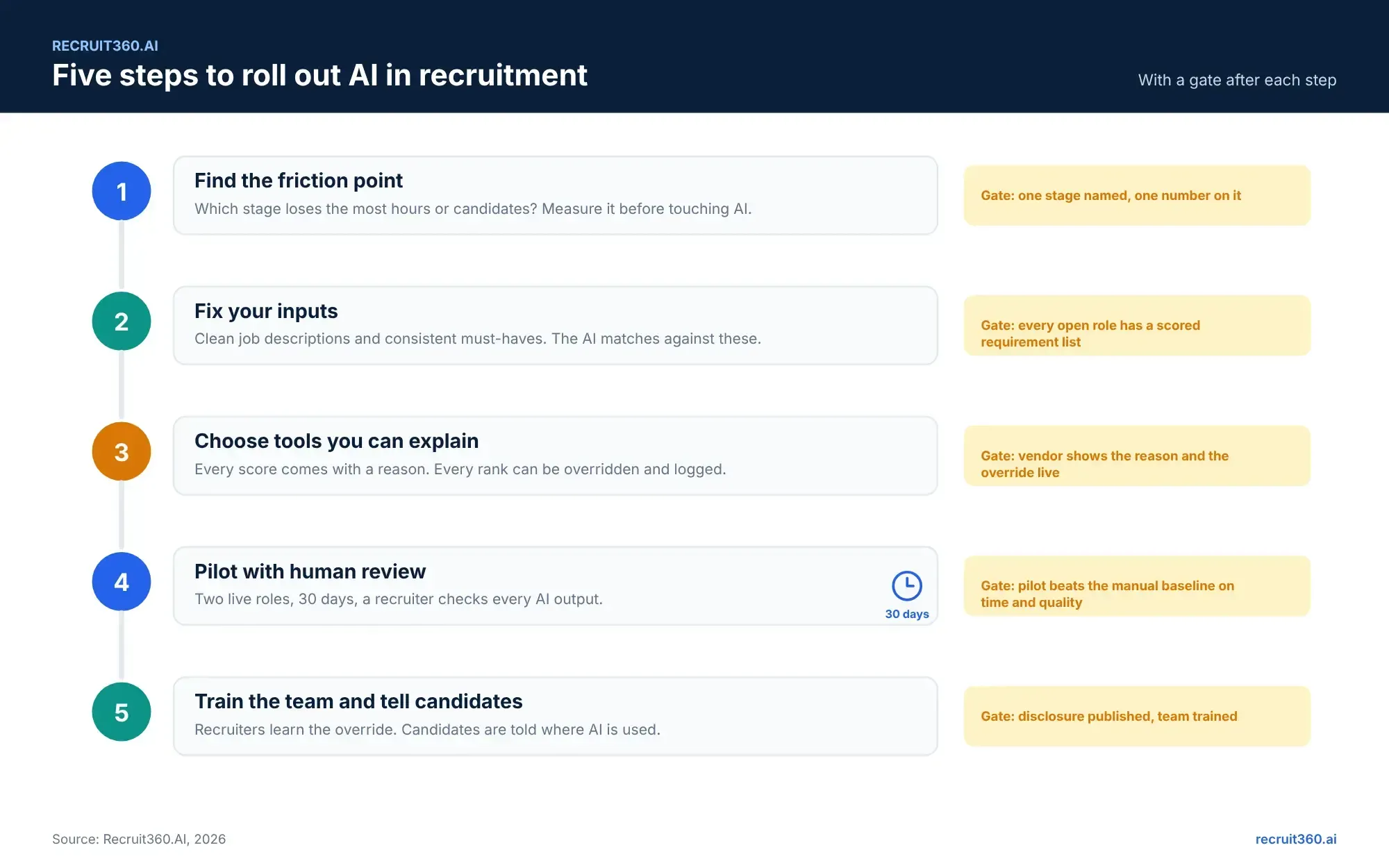
- Roll it out in five steps over 90 days. Find the friction point, fix your inputs, choose tools you can explain, pilot with review, train and disclose.
- AI will not replace recruiters. It will change what they spend the day on.
Two years ago a recruiting team would test AI on one role and go back to the spreadsheet. That is over. Testlify's 2026 guide calls this the year of AI integration rather than experimentation, and the pressure comes from both sides: application volume is up, and most of those applications were written with AI too (Testlify). This guide covers what AI in recruitment means in 2026, where it pays off, where it goes wrong, and how to roll it out without creating a compliance problem.
What AI in recruitment means in 2026
Three technologies get called "AI" in hiring, and they are not the same thing. Automation follows rules. Machine learning finds patterns in your data. Generative AI writes and summarises. Most recruiting platforms use all three.
AI vs machine learning vs automation in hiring
| Automation | Machine learning | Generative AI | |
|---|---|---|---|
| What it does | Runs a fixed rule when a trigger fires | Learns a pattern from past data and applies it to new data | Produces text, summaries or questions from a prompt |
| Hiring example | Send a confirmation email when a candidate applies | Rank candidates by fit, learned from past hires | Draft a job description; summarise an interview |
| Risk | Rule is wrong and fires a thousand times | Pattern carries bias from past decisions | Output sounds right and is wrong |
| Control | Review the rule | Audit the model, explain the score, allow override | A person edits before anything is sent |
For the automation half of this, see our guide to recruitment automation. This post is about the machine learning half, where the risk and the payoff are both larger.
Why AI in recruitment matters now
Application volume and AI-written resumes
A single posting can draw hundreds of applications in a day. Many are written or polished by AI, which makes them read well and tell you little. Testlify's 2026 guide notes that resume quality is getting harder to trust, so skills-first evaluation and consistent scoring matter more (Testlify). Reading all of them by hand is no longer a plan.
The shift to skills-based hiring
More teams hire on what a person can do rather than where they studied. That needs a system that reads for skills across every resume the same way. Humans do this inconsistently across 400 resumes. A model does it the same way every time, which is the point and the risk.
Adoption: what the surveys say
Adoption figures vary by survey and by what counts as "using AI". Rather than quote a headline number, we recommend reading the primary surveys from SHRM, Gartner or LinkedIn for your region and company size. The direction in every one of them is the same: up. [Insert one sourced adoption statistic here with the survey name, year and link before publishing.]
Benefits of AI in recruitment: faster screening, consistent evaluation, better reporting
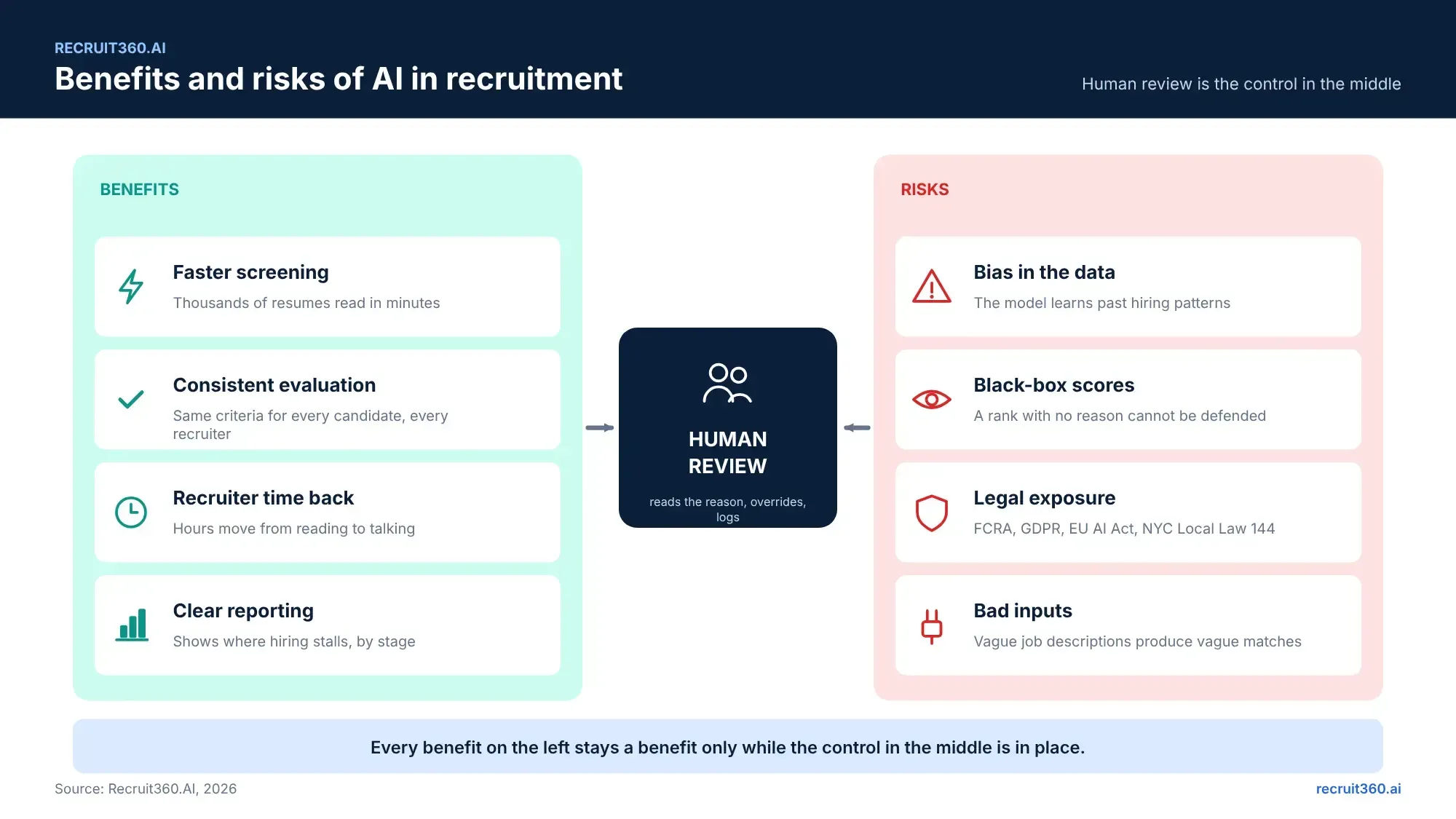
Four benefits show up in the numbers a talent acquisition leader reports. Each one depends on the inputs being clean: a clear job description, consistent must-haves and a model that learns from your outcomes.
Faster screening and shortlisting
The model reads every resume before the recruiter opens the role. The shortlist exists on day one instead of day three. This is the benefit that moves time-to-fill, because the hiring manager gets candidates sooner. Our post on AI resume screening walks through the four-step pipeline.
Consistent evaluation across recruiters
Two recruiters reading the same 200 resumes will shortlist different people. A model scores every one against the same weighted criteria. Consistency is not the same as fairness, but it is a precondition for it: you cannot audit a process that changes with the reader.
Better use of recruiter time
Hours that went into reading go into calls, interviews and offers. The recruiter count does not change. What they do with the week does.
Reporting that shows where hiring stalls
When the AI sits inside the recruitment management system, every stage is timestamped. The report shows requisitions stuck in approval, roles with no shortlist after a week, and agencies that send volume without fit.
Challenges and risks of AI in recruitment: bias, compliance, trust and data quality
The risks are as well documented as the benefits. Three categories of limitation appear across 2026 research: bias, transparency and scaling gaps (CS Recruiters, citing IBM). A fourth, data quality, sits underneath all three.
Bias and fairness
A model trained on past hires learns past patterns, including the ones nobody chose on purpose. If the company hired from three universities for ten years, the model may favour those three. The control is a bias audit with a date on it, a score that explains itself, and a rule that no candidate is rejected on a score alone.
Legal and compliance: FCRA, GDPR, EU AI Act, NYC Local Law 144
Four frameworks matter in 2026. In the United States, a proposed class action against Eightfold AI, filed in January 2026 over alleged Fair Credit Reporting Act violations, shows that AI's effect on candidates now carries legal risk (Greenhouse). New York City's Local Law 144 requires a bias audit for automated employment decision tools. In the EU, GDPR gives candidates a right to an explanation of automated decisions, and the AI Act lists recruitment systems as high-risk, with documentation and oversight duties (EU AI Act, Annex III). The control for all four is the same: human decision, logged override, written policy, candidate disclosure.
Transparency and candidate trust
Candidates increasingly ask whether AI read their application. A team that cannot answer loses trust and, in some jurisdictions, breaks the law. Say where AI is used, in the job posting and the application flow.
Integration and data quality
A model that matches against a vague job description produces vague matches. One that cannot see agency submissions scores half the pipeline. Before the model, fix the requisition template and connect the vendor portal. The AI is only as good as what it can read.
How AI is used across the hiring workflow
Sourcing and job descriptions
Generative AI drafts the job description from the requisition. Sourcing tools search for people who match it. A recruiter edits the draft before it goes live; a model's first version reads well and usually asks for too much.
Screening and matching
This is where machine learning earns its place. The model parses every resume, matches on meaning, scores against the must-haves and ranks the list. The recruiter reads the top of the list and the reason beside each name.
Scheduling and candidate communication
Automation here is older and safer. Candidates pick interview slots from a calendar. Status emails go out when a stage changes. A chatbot answers the questions candidates ask most. None of this needs a model that learns; it needs rules that work.
AI interviews, screening calls and assessments
An AI interview agent can run the first round with adaptive questions, transcribe and score the answers, and an AI calling agent can phone candidates to confirm interest and book a slot. AI can also score tone and confidence from video, which is the riskiest use in the stack. Keep video scoring advisory, or leave it out, and keep a recruiter reviewing every agent result.
Vendor submissions and reporting
Agency candidates get the same AI score as direct applicants when they arrive through a vendor portal. Reports build from stage timestamps. Leadership sees time-to-fill by department and fill rate by agency without a recruiter building a spreadsheet.
What AI in recruitment means for each role
Corporate recruiters
Your day moves from reading to talking. You start each role with a ranked list. Your job is to check the reasons, override where the model is wrong, and log why. That log is how the model learns your judgment.
Hiring managers
You set the must-haves when you open the requisition. The scores reflect them. You see fewer, better profiles, and your feedback in the system shapes the next shortlist. Give it fast.
HR and talent acquisition leaders
You own the policy. Decide now how AI scores are used in rejection decisions, what candidates are told, and who audits the model. Then report time-to-fill, stage conversion and agency performance from one dashboard.
IT and HRIS admins
You own the data path. Ask every vendor for SOC 2 and GDPR evidence, role-based access, an API to the HRIS, a retention schedule and a model audit log. Keep agencies in a scoped portal, not in your core system.
How to implement AI in recruitment: 5 steps
Ninety days is enough if you do one thing at a time. Each step has a gate. Do not pass it without a yes.
Step 1. Find the friction point
Which stage loses the most hours or the most candidates? Screening volume on high-traffic roles is the usual answer, but measure before you assume. Gate: one stage named, with a number on it.
Step 2. Fix your inputs: job descriptions and data
The model matches against the requisition. If the requisition says "strong communicator" and nothing else, the match is noise. Rewrite the template so every role carries scored must-haves. Connect the vendor portal so the model sees agency candidates. Gate: every open role has a scored requirement list.
Step 3. Choose tools you can explain
Every score comes with a reason. Every rank can be overridden and the override is logged. The vendor can show you a bias audit with a date. If any of those is missing in the demo, move on. Our guide to the AI recruitment management system has the ten questions to ask. Gate: the vendor shows the reason and the override live.
Step 4. Pilot with human review for 30 days
Two live roles, one high-volume and one specialist. A recruiter checks every AI output and logs every override. At day 30, compare screening hours, days to shortlist, hiring manager satisfaction and override rate against the manual baseline. Gate: the pilot beats the baseline on time without losing quality.
Step 5. Train the team and tell candidates
Recruiters learn how to read the reason and when to override. Hiring managers learn to set must-haves. Candidates are told, in the posting and the application flow, where AI is used. Gate: disclosure published, team trained, policy written.
Will AI replace recruiters?
No, and the vendors who say it will are the ones to question first. AI reads, matches and ranks. Recruiters interview, judge, negotiate and close. The teams getting the most from AI in 2026 hire faster with the same headcount, because the hours moved from reading resumes to talking to the people on the shortlist. The recruiter who understands the model's reasons and knows when to override them is more valuable than before, not less.
Frequently asked questions
What is AI in recruitment?
AI in recruitment is the use of machine learning, language models and automation to do repeat hiring tasks: reading resumes, matching candidates to roles, scoring fit, scheduling interviews and reporting on the pipeline. A person reviews the output and makes the decision.
What are the benefits of AI in recruitment?
Faster screening, consistent evaluation across recruiters, recruiter hours moved from reading to interviewing, and reporting that shows where hiring stalls.
What are the risks of AI in recruitment?
Bias learned from past hiring data, scores with no explanation, legal exposure under FCRA, GDPR, the EU AI Act and local bias-audit laws, and poor matches from vague job descriptions.
Is AI in recruitment legal?
Yes, with conditions that vary by jurisdiction. New York City requires a bias audit. The EU classes it as high-risk under the AI Act and gives candidates explanation rights under GDPR. In the US, FCRA claims are being tested in court. A human decision, a logged override and candidate disclosure are the common ground.
How do I measure ROI from AI recruiting?
Four numbers from the pilot: screening hours per role, days to shortlist, hiring manager satisfaction with the shortlist, and quality of hire at 90 days. Compare against the roles you ran by hand.
What is the best AI tool for recruitment?
It depends on where your friction is. For inbound volume, an ATS with AI screening. For sourcing passive candidates, a sourcing tool. For teams with requisitions, agencies and many hiring managers, an AI recruitment management system that runs the whole lifecycle.
For a tool-by-tool view, see the best AI recruiting software compared by type.