

AI resume screening is software that reads every resume for a role, matches each one to the job on meaning rather than keywords, scores it against the requirements you set, and ranks the list. A recruiter reviews the top of the list and the reason beside each name. It replaces the hours of reading, not the decision.
Key takeaways:
- AI resume screening is a four-step pipeline: parse, match, score, review. The recruiter is step four.
- It fixes two problems a keyword filter cannot: resumes that use different words for the same work, and inconsistency between recruiters.
- It fails in two predictable ways: good candidates with unusual resumes, and bias carried in from the training data.
- Buy on eight checks, starting with whether every score comes with a reason.
A single posting can draw 400 resumes in a week. A recruiter reads about 40 an hour with attention, less by the afternoon. The old answer was a keyword filter, which cut the pile and cut good people with it. AI resume screening is the current answer. This post explains how it works step by step, what it gets right, where it goes wrong, and what to check before you buy AI resume screening software. It is written for the recruiter and the HR leader, not the job seeker.
What AI resume screening is
AI resume screening uses natural language processing and machine learning to read, compare and rank resumes against a role. Designveloper's guide puts it simply: it helps recruiters decide which applications need attention first (Designveloper). It does not decide who gets hired. It decides who gets read first.
AI resume screening vs ATS keyword filters
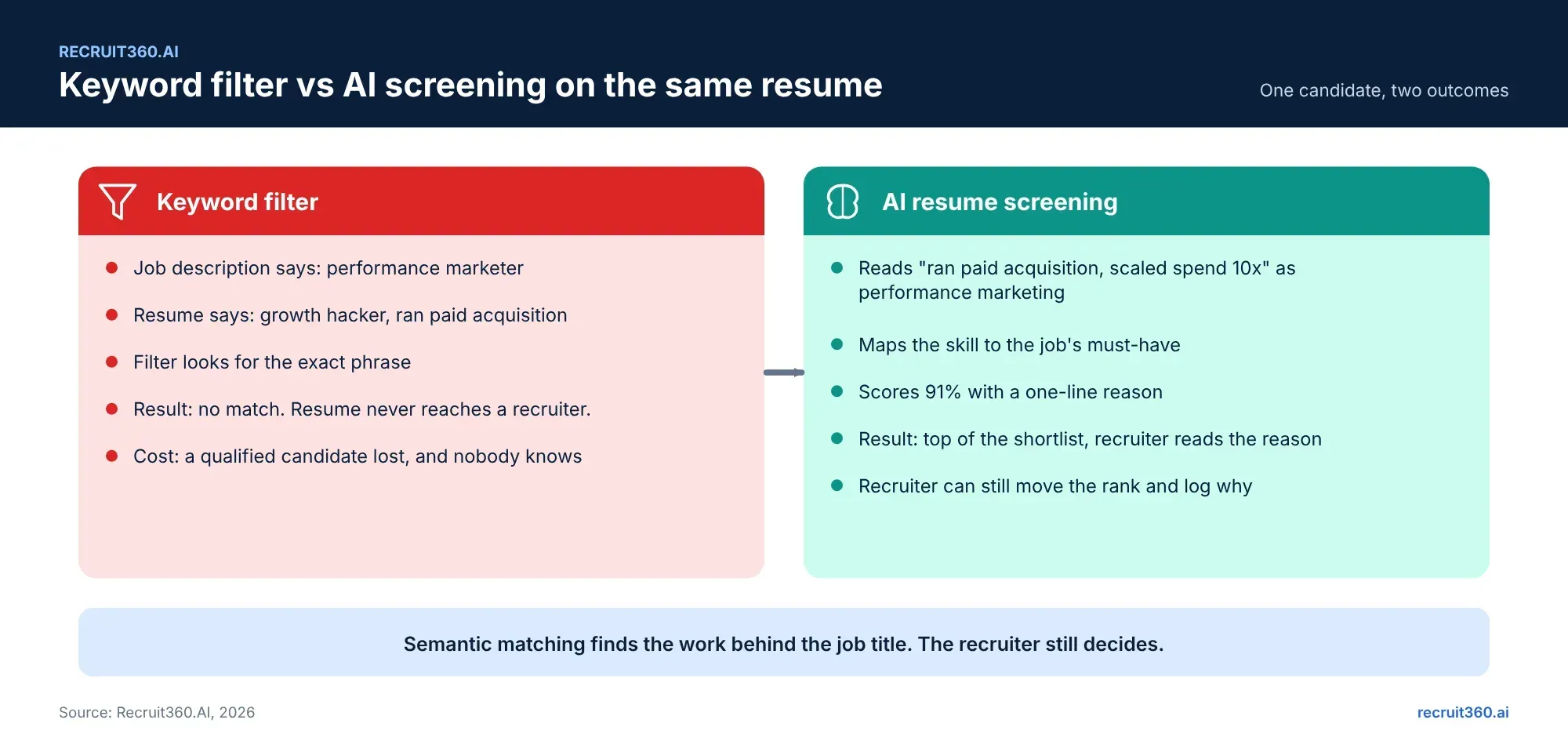
An applicant tracking system filter looks for words. If the job says "performance marketer" and the resume says "growth hacker", the filter misses. Resume screening AI reads for meaning, so the same resume matches. That one difference is why the two should not be confused.
If the first round is the bottleneck, see what AI interview software and AI screening calls can take off the recruiter's desk.
| Keyword filter | AI resume screening | |
|---|---|---|
| Reads | Exact words and phrases | Meaning, context, skills behind job titles |
| Matches on | Presence of the phrase | Fit to the requirement, with a confidence score |
| Handles synonyms | No | Yes |
| Explains the result | No; it is pass or fail | Yes, with a reason beside the score |
| Learns | No | Yes, from your hiring outcomes |
| Risk | Misses good people who use different words | Carries bias from training data if not audited |
Why manual resume screening breaks at volume
The two problems: hours per role and inconsistency between recruiters
The first problem is time. At 40 resumes an hour, 400 resumes is ten hours, spread over three days because nobody reads for ten hours straight. The shortlist reaches the hiring manager on day four.
The second problem is quieter. Two recruiters reading the same pile will not shortlist the same people. Neither is wrong; they weight things differently. The hiring manager gets a list that depends on who read the pile, and nobody can audit why.
How AI resume screening works, step by step: parse, match, score, review
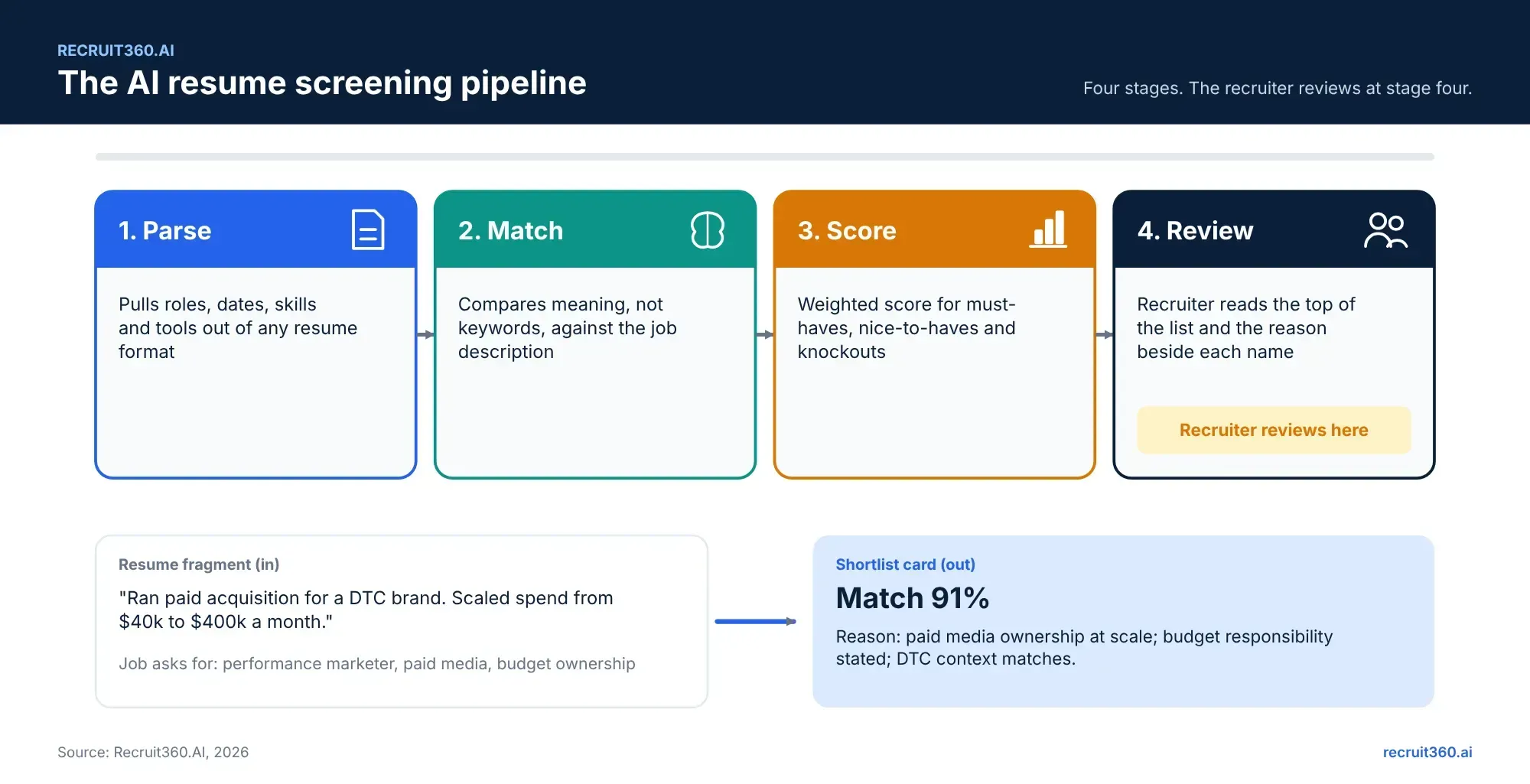
Every AI resume screening tool follows the same four stages. Vendors differ in how well each stage works and how much of it a recruiter can see.
1. Parsing and data extraction
The resume comes in as a PDF, a Word file or a web form. Parsing turns it into fields: roles, employers, dates, skills, tools, education, location. AI resume parsing reads the text rather than the layout, so a two-column design or a resume exported from a phone still parses. If this step fails, nothing after it works. Check it by opening a parsed record and looking for a missing section.
2. Semantic matching against the job
Matching compares the parsed resume to the job requirements on meaning. "Ran paid acquisition and scaled monthly spend tenfold" matches a role asking for a performance marketer with budget ownership, though the words differ. This is the step that separates AI screening from a keyword filter. Check it by asking the vendor to show a resume that uses different language from the job and still matches.
3. Scoring and ranking
Scoring applies the weights the hiring manager set. Must-haves count more than nice-to-haves. A knockout rule, such as a required work permit, moves a candidate off the ranked list but keeps the record. Ranking orders the result. In a system that learns from your hires, the ranking improves over months. Check it by asking where the weights came from.
4. Knockout rules and the recruiter review
The ranked list reaches the recruiter with a reason beside each name. The recruiter reads from the top, moves anyone up or down, and the system logs the change. This is the step that makes the whole pipeline defensible. Automated resume screening without a review step is a rejection machine, and in several jurisdictions it is not legal.
Benefits of AI resume screening software: time, consistency and coverage
Time: from days of reading to minutes of review
The shortlist exists before the recruiter opens the role. The ten hours of reading become one hour of reviewing the top 30 and the reasons. The hiring manager gets the list on day one.
Consistency: the same criteria for every resume
Every resume is scored against the same weighted requirements. The list no longer depends on which recruiter read the pile or what time of day they read it. That consistency is also what makes a bias audit possible.
Coverage: no resume goes unread
In a manual process, the resume that arrives on day six of a hot role gets a glance. With AI screening every resume gets the same read, including the agency submissions that come through the vendor portal. The 400th applicant has the same chance as the first.
Where AI resume screening fails: false negatives, bias and unexplained scores
False negatives: good candidates with unusual resumes
A career changer. A founder whose last title was "CEO" of a three-person company. A self-taught engineer with no degree line. The model has seen fewer of these, so it ranks them lower. The fix is the review step: a recruiter who reads past the top ten and moves people up, and a vendor whose model learns from that override.
Bias carried in from training data
A model trained on who was hired learns who was hired. If that history favoured certain schools, cities or career paths, the model will too. The fix is a bias audit with a date on it, a model that explains its score, and a rule that no candidate is rejected on a score alone. Our guide to AI in recruitment covers the laws that now require this.
Scores with no reason attached
A score of 84 with nothing beside it cannot be checked by a recruiter, explained to a hiring manager or defended to a candidate. If the tool cannot show the reason, treat the score as a sort order, not a judgment.
What AI resume screening means for each role
Corporate recruiters
You start every role with a ranked list and a reason beside each name. Read from the top, but read past it. Log why you override; that log trains the model and protects the team.
Hiring managers
You set the must-haves and the weights when you open the requisition. The scores reflect them. If the shortlist looks wrong, the weights are usually the reason, and you can change them.
HR and talent acquisition leaders
You own the policy on how scores are used. Advisory only. Human decision. Candidate disclosure. Decide it before the first role runs, and ask the vendor for the bias audit every year.
IT and HRIS admins
You own the data path. Where resumes are stored, for how long, who can read them, and how the model's decisions are logged. Ask for the retention schedule and the audit log before the contract.
Checklist for choosing AI resume screening software
Eight checks. If the answer to the first one is no, stop there.
- Every score comes with a reason a recruiter can read in one line.
- A recruiter can override any rank, and the override is logged with a name and a time.
- The vendor can show a bias audit, with a date under twelve months old.
- The demo includes a resume that uses different words from the job and still matches.
- The tool connects to your ATS or recruitment management system and your vendor portal, so agency resumes are screened too.
- Candidate data has a retention schedule and a deletion process.
- Candidates are told that AI is used, in the posting and the application flow.
- Pricing is clear: per seat, per resume or per hire, with implementation quoted separately.
Inside Recruit360.AI, the four steps above are the Profile Recommendation Engine, and screening is one stage of the recruitment management system rather than a separate tool, so agency submissions through the vendor portal get the same score as direct applicants and the override log sits on the candidate record. The AI recruitment management system guide shows how the screening stage connects to the rest.
Which of these steps to automate, and which to keep human, is the subject of our recruitment automation guide.
Frequently asked questions
What is AI resume screening?
AI resume screening is software that reads every resume for a role, matches it to the job on meaning, scores it against the requirements and ranks the list for a recruiter to review. It replaces the reading, not the decision.
Is AI resume screening biased?
It can be, because the model learns from past hiring data. The controls are a dated bias audit, a reason beside every score, a human override that is logged, and no rejection on a score alone.
Do recruiters still read resumes after AI screening?
Yes. They read the ranked list from the top, with the reason beside each name, and they read past the top ten to catch unusual candidates. The hours change; the reading does not stop.
What is the difference between resume parsing and resume screening?
Parsing turns a resume into fields: roles, dates, skills. Screening uses those fields to match, score and rank candidates against a job. Parsing is step one of screening.
Can AI resume screening reject candidates automatically?
Some tools can. It is a bad idea and, in New York City and under the EU AI Act, it is regulated. Keep the score advisory and the decision with a person.