

AI interview software runs the first round of hiring without a recruiter on the line, in one of three formats: an AI voice agent that phones the candidate with screening questions, an asynchronous video interview recorded against set questions, or a chat interview by text. Each returns a transcript and a summary for a recruiter to review. No format should make the hiring decision on its own.
Key takeaways:
- An AI screening call confirms interest, notice period, location and pay in four minutes and writes the answers to the record. That is the stage most worth automating.
- A field experiment of about 70,000 candidates found AI voice interviews produced more offers and more starts than human-led first rounds, and 78 per cent of candidates chose the AI option when offered.
- Most candidates still do not trust AI to judge them: Gartner found 26 per cent do. Tell them in advance, let them opt for a person, and keep the decision human.
- Video scoring of tone and expression is the use regulators look at hardest. Keep it advisory or leave it out.
- Cost ranges from about $1 per interview on credit plans to enterprise contracts in the tens of thousands of dollars a year.
The pages that rank for AI interview software are lists of ten tools, some of them built for candidates practising rather than recruiters hiring. The pages for AI screening calls are explainers from one vendor. Nobody puts the two side by side, compares the formats in a table, or covers India: regional languages, WhatsApp follow-up, cost per call in rupees, consent under the DPDP Act. This guide does all four and ends with a 30-day rollout. It is also the page that explains Recruit360.AI's AI Interview and Agent Calling, with the disclosure that we sell them.
What AI interview software is (and what it is not)
AI interview software asks a candidate structured questions, records the answers, transcribes them and summarises them against a rubric. It is not a decision engine. The AI in recruitment guide sets out why the decision stays with a person; this guide covers the formats and the buying.
Three formats: AI voice screening calls, async video interviews, chat screening
Voice: an AI agent phones the candidate, holds a short conversation, and writes structured fields plus a transcript. Best for high-volume screening of interest, logistics and basic fit. Async video: the candidate records answers to set questions on their own time; the system transcribes and may score. Best for roles where communication is the job. Chat: a text conversation on web or WhatsApp, with the same structured questions. Best for candidates on slow connections and for anyone who would not answer an unknown number.
What an AI interviewer scores, and what it should only transcribe
It can score the content of answers against a rubric: did the candidate name the right tools, describe a relevant project, confirm the notice period. It should only transcribe anything about the person rather than the answer: tone, pace, expression, accent, confidence. Content scoring is explainable; a recruiter can read the answer and agree or disagree. Person scoring is not, and it is where the bias audits and the lawsuits concentrate.

How AI screening calls work, step by step
A stage change triggers the call: a candidate applies, or a recruiter shortlists ten profiles. The agent calls at a time the candidate chose or inside a window they were told about. It introduces itself as an AI assistant for the named role and asks whether now is a good time. It asks five to eight questions from the rubric: interest, location and work mode, notice period and buyout, current and expected pay, one or two role-specific questions. It thanks the candidate, tells them what happens next, and offers WhatsApp for follow-up. The transcript and the structured fields land on the candidate record, and a recruiter reviews the summary before anything moves.
Agent Calling in Recruit360.AI: interest, notice period, expected pay, availability
Agent Calling is the voice format inside Recruit360.AI. It runs on a stage change or on a recruiter's shortlist, asks for consent to record at the start, asks the rubric in the candidate's preferred language where supported, and writes interest, notice period, buyout, current and expected CTC and availability to the record with the transcript. It does not score and does not reject. The recruiter sees the summary and decides who moves to the AI Interview or to a human interview.
How AI interviews work after the screening call
The screening call filters logistics. The AI interview is the structured first round. The candidate books a slot or starts immediately, answers eight to twelve questions by voice or video, and the system transcribes and summarises each answer against the rubric the hiring manager wrote. The recruiter and hiring manager read the summary and the transcript, not a single number, and decide who goes to the panel.
AI Interview in Recruit360.AI: structured first round, candidate picks the time, transcript and summary
AI Interview takes the rubric from the requisition, lets the candidate pick a time including evenings and weekends, runs the structured interview, and returns a transcript, a summary per question and the candidate's own closing questions. Scores are shown per question beside the answer, so a reviewer can see why. Video is optional; where it is on, the system transcribes and does not score expression or tone. Consent is asked before recording, and the recording follows the requisition's retention rule under the DPDP checklist.
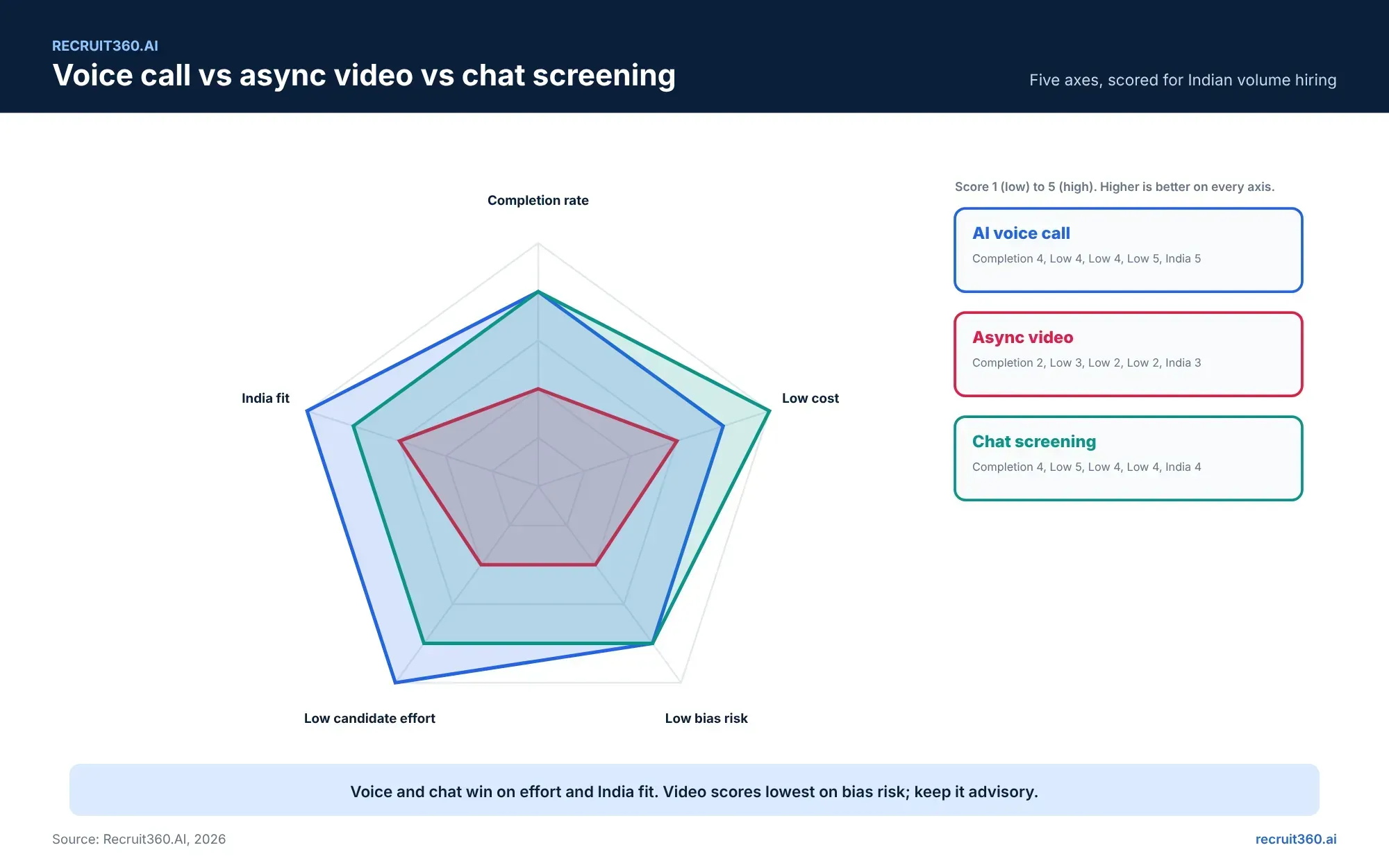
AI voice call vs async video vs chat screening: which to use when
| AI voice call | Async video interview | Chat screening | |
|---|---|---|---|
| Best stage | First contact and logistics screen | Structured first round | First contact where calls are unwelcome |
| Candidate effort | Four minutes on the phone | Fifteen to thirty minutes, camera, quiet room | Five to ten minutes, any device |
| Completion | High when the call is expected | Lowest of the three; drop-off is the known problem | High; Sapia reports 75 per cent on its chat-plus-video flow (vendor figure) |
| Bias risk | Low if only content is scored | Highest, if tone or expression is scored | Low if only content is scored |
| India fit | Strong: works on any phone, regional languages where supported | Weaker: bandwidth, privacy at home, comfort on camera | Strong: WhatsApp-native, works on slow connections |
| Typical cost | Per call or per minute; credit plans from about $1 per interview | Per interview or per role; Willo from about $59 per live role, enterprise from thousands a year | Per conversation; often bundled |
| What the recruiter gets | Structured fields and a transcript | Transcript, summary, optional per-question scores | Transcript and structured fields |
Benefits of AI interview software, with the numbers that are real and the ones that are not
The real number comes from a field experiment, not a vendor. Researchers at Erasmus University and Chicago Booth ran AI voice interviews against human-led first rounds with about 70,000 applicants. Candidates interviewed by the AI received 12 per cent more offers, 18 per cent more started the job, and 17 per cent more were still there after 30 days; when given the choice, 78 per cent picked the AI interview, and 7 per cent had technical problems . That is one study in one setting, but it is the best evidence available that a well-built voice screen does not cost you candidates.
The vendor numbers are different. Sapia reports 75 per cent completion on its chat-plus-video flow and a 9 out of 10 candidate satisfaction score ; HireVue reports 70 million interviews run. Treat these as what the vendor measured on the vendor's customers. The benefits that hold across both kinds of evidence: screening runs at night and on weekends, every candidate gets the same questions, the recruiter reads a summary instead of making thirty calls, and the structured fields land on the record without typing.
Risks specific to AI interviews: cheating, drop-off, trust and video scoring
The general risks of AI in hiring, from biased screening to black-box scores and the legal map, are covered in AI in recruitment: benefits, risks and a rollout plan. This section covers only what is specific to interviews. Trust first. Gartner found 26 per cent of candidates trust AI to evaluate them fairly, 32 per cent fear being rejected by AI, and a quarter trust an employer less when AI is used ; only 30 per cent said they were open to AI-led interviews in a later survey. The gap between that and the 78 per cent who chose the AI option in the field study is explained by one thing: being told in advance and offered a choice.
Cheating is real on async video and chat, where a candidate can read a generated answer. Voice calls make it harder; a follow-up question does the rest. Drop-off is highest on video. Bias lives wherever the system scores the person rather than the answer. The AI resume screening guide covers the same four-step control: explain, override, log, audit.
Video scoring is the riskiest use; keep it advisory or leave it out
Scoring tone, expression or confidence from video is the use that Illinois legislated first and that New York's bias audit rule reaches. It is also the use candidates distrust most. Transcribe video; do not score it. If a vendor's demo leads with an emotion score, that is the moment to ask what the model was trained on.
Is AI interviewing legal? The rules in India, the US and the EU
India: DPDP consent and notice for recordings
India has no AI-specific hiring law. MeitY's AI Governance Guidelines of November 2025 are not binding and do not cover hiring. What applies is the DPDP Act: a recording and a transcript are personal data, so the candidate gets a notice and gives consent before the call, the data is used only for the role, and it is erased when the purpose ends. Those obligations take effect on 13 May 2027 under the DPDP Rules. The DPDP Act for recruiters guide has the checklist.
NYC Local Law 144, Illinois and the EU AI Act for global clients
Three rules reach AI interviews directly. New York City's Local Law 144, enforced since 5 July 2023, treats an interview-scoring tool as an automated employment decision tool: it needs an independent bias audit within a year of use, a published summary, and notice to candidates at least ten business days before use . Illinois's AI Video Interview Act, in force since 2020, is the one written for this format: notify the candidate, explain how the AI works, get consent, limit sharing of the video, and delete it within 30 days on request. The EU AI Act classes recruitment systems as high risk, with those obligations now due on 2 December 2027 after the July 2026 Digital Omnibus. The wider regulatory picture is in AI in recruitment; for an interview tool, ask the vendor for the bias audit and the candidate notice text.
AI interview tools compared
Facts are from each vendor's site or a named listing on 15 October 2026. Pricing is rarely public.
| Tool | Format | Languages | Pricing (Oct 2026) | Note |
|---|---|---|---|---|
| Recruit360.AI (Agent Calling and AI Interview) | Voice screening call; structured AI interview, video optional | Candidate's preferred language where supported | Included in pay-as-you-go pricing | Inside the RMS; no separate contract |
| HireVue | Voice AI interviewer, live and async video, assessments | Not listed | Not published; third-party estimates in the tens of thousands of dollars a year | Enterprise; 40 per cent of Fortune 100 claimed |
| Paradox (Olivia) | Chat and SMS screening, scheduling, video | 100 plus | Not published | High-volume hourly hiring |
| Sapia.ai | Async chat interview | Multiple | Not published | 10 million interviews claimed |
| InCruiter (India) | One-way AI video, AI phone screening, expert interviews | Indian market | Pay for what you use; prices on request | Indian incumbent |
| Hyring (India) | Async and live AI video, AI phone screener | Not listed | Lite $99 a month for 20 credits; Growth $1,999; Pro $4,999; about $1 to $5 per interview | Credit-based |
| Willo | Async video | 18 plus | Lite about $59 per live role; Enterprise from about 2,999 pounds a year | SMB |
| Humanly | AI video, voice and async, chat engagement | Not listed | Not published | US mid-market |
Six short reviews
Recruit360.AI, disclosure: ours. Best for teams that want screening calls and first-round interviews inside the same system as the requisition, the shortlist and the vendor portal, with no separate AI contract. HireVue: best for enterprises running tens of thousands of interviews a year with a legal team to manage the audits. Paradox: best for hourly, high-volume hiring where chat and scheduling are the whole job. Sapia: best for chat-first screening at scale with published candidate experience data. InCruiter and Hyring: the Indian options, with Hyring publishing credit-based prices and InCruiter quoting on request. Willo: the low-cost async video choice for small teams outside India.
How to roll out AI screening calls in 30 days without losing candidates
Week one: pick one role with volume, write the rubric with the hiring manager, and write the notice and consent text. Week two: run the calls on new applicants only, with a recruiter reading every summary and a human option offered in the first message. Week three: compare completion rate, time to shortlist and candidate feedback against the previous month's roles run by hand. Week four: decide whether to add the AI interview as the first round, and write the one-page rule for what the AI may and may not decide. Recruitment automation has the same 90-day shape for the rest of the workflow.
Why Recruit360.AI is built for AI interviews and AI screening calls
Agent Calling and AI Interview are not add-ons bought from a second vendor and wired in. They run on the requisition's rubric, trigger on a stage change, ask for consent, write to the candidate record, and follow the retention rule set on the requisition. Scores sit beside the answer they came from, never beside the person. A recruiter reviews every summary, and nobody is rejected by the system. Both are included in pay-as-you-go pricing. The demo is a live call to a candidate you choose, and the 15-day free trial runs the screen on a real role.
Frequently asked questions
What is AI interview software?
Software that runs a structured first-round interview or screening conversation without a recruiter present, by voice call, recorded video or chat, and returns a transcript and a summary against a rubric for a person to review.
What is an AI screening call?
A short phone conversation run by an AI voice agent that confirms interest, location, notice period, pay expectations and a few role questions, then writes the answers to the candidate record. It usually takes about four minutes.
Do candidates accept AI interviews?
More than surveys suggest, when told in advance and given a choice. In a field experiment of about 70,000 applicants, 78 per cent chose the AI voice interview when offered, and those interviewed by AI received more offers. Surveys of candidates in general show lower trust: Gartner found 26 per cent trust AI to evaluate them fairly.
Can candidates cheat an AI interview?
On async video and chat, a candidate can read a generated answer. Voice calls with follow-up questions make it harder. Treat the AI round as a screen, not a verdict, and verify in the human interview.
Should AI make the hiring decision?
No. Score the content of answers against a rubric, show the score beside the answer, and let a recruiter decide. Scoring tone or expression from video is the use regulators and candidates object to most.
Is AI interviewing legal in India?
There is no AI-specific hiring law. The DPDP Act treats recordings and transcripts as personal data: give notice, get consent before recording, use the data only for the role, and erase it when the purpose ends. Those duties apply from 13 May 2027 under the Rules.
What does AI interview software cost?
From about $1 per interview on credit plans such as Hyring, through per-role pricing such as Willo at about $59 per live role, to enterprise contracts in the tens of thousands of dollars a year. Recruit360.AI includes Agent Calling and AI Interview in its pay-as-you-go pricing.
Does AI screening work in Indian regional languages?
Some tools do; Paradox lists more than 100 languages. Ask the vendor which Indian languages the voice agent supports and test one call before buying.
Which format has the best completion rate?
Voice and chat, because they take minutes on any phone. Async video has the highest drop-off because it needs a camera, a quiet room and time. Vendor figures vary; measure your own in the first month.
How long does it take to roll out AI screening calls?
About 30 days: a rubric and consent text in week one, calls on one role in week two, a comparison with the manual process in week three, and a decision and written rule in week four.